
OUR MISSION IS TO TAILOR FOR EACH CLIENT A BEAUTIFUL, FUNCTIONAL AND ENDURING OUTDOOR ENVIRONMENT THAT WILL PROVIDE A PLACE OF SERENITY FOR FRIENDS AND FAMILY TO APPRECIATE FOR YEARS TO COME.

BuildCal Landscape Hardscape / Patio Article
Fire Pit Rules and Clearances in SoCal - Gas vs. Wood and How to Stay Code-Compliant
QUICK ANSWER
There is no single "California fire pit clearance" that safely answers every project. Treat any online distance as a screening number, not a construction specification. Identify the fire-feature category first, then check the current local fire and building rules, air-district restrictions, HOA requirements, and the manufacturer's listed clearances before finalizing the site.
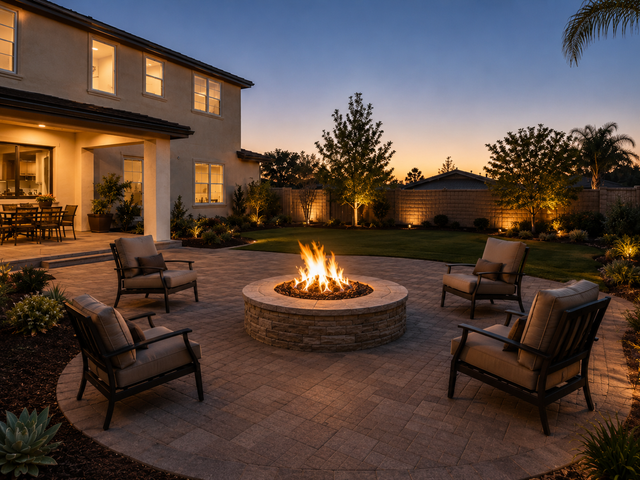
A fire pit can become the heart of an outdoor room, but the layout has to work safely before the flames are ever lit. The trouble is that a single distance copied from a generic article can leave you with a feature that is beautiful, expensive, and not actually compliant with your city, HOA, or air district. If you are researching fire pit rules and clearances, start with the complete safety envelope: the fire feature itself, nearby structures and eaves, furniture, fences, fuel, overhead elements, and the conditions that can temporarily prohibit use. Gas and wood also create very different planning questions, and local requirements are rarely identical from one city to the next. This guide organizes the checks to complete, in the right order, before you choose the stone or seating, so the finished fire pit is safe, legal, and comfortable to gather around.
Start With the Fire Feature You Are Actually Building
Two fire pits that look almost identical in a rendering can fall into different safety and permit questions. Before measuring clearances, define the appliance. It also helps to weigh which backyard upgrades are worth the money in SoCal so the fire feature earns its place in the budget.
Portable Gas Fire Bowl or Table
These are typically listed appliances fueled by a propane cylinder or a fixed natural-gas connection. The manufacturer's installation instructions and required clearances are central. A portable appliance also does not automatically mean "no rules" — local fire restrictions, fuel-cylinder requirements, and placement still matter.
Portable Wood-Burning Fire Pit or Chiminea
This introduces sparks, embers, smoke, and solid-fuel air-quality restrictions. It may be treated as a portable outdoor fireplace or another recreational-fire category depending on the jurisdiction and the specific device.
Built-In Gas Fire Pit and Fuel Piping
Once the feature is permanently constructed and connected to fuel piping, the project is no longer only a furniture-placement decision. Burner listing, ventilation, shutoff access, gas piping, hardscape construction, and local permit and inspection requirements can all enter the picture.
Wood-Burning Recreational Fire or Permanent Outdoor Fireplace
These can face the strictest combination of separation, ember, wildfire, and air-quality concerns. A permanent wood-burning device can also raise different questions from a small open recreational fire. Do not use a gas-fire-pit article as the code basis for a wood-burning installation.
Why the Fire Pit Clearance Number Changes
The statewide fire-code framework distinguishes among open burning, recreational fires, and portable outdoor fireplaces. Those categories do not share one setback. Local cities can also amend or clarify the way the rules apply, and a manufacturer's listing can require more separation than the minimum you found in a code summary.
As a practical example, the City of Glendale currently says small recreational fire pits at single-family homes may be used when they follow the manufacturer's instructions and maintain at least 15 feet of clearance from structures, fences, and dry vegetation. Glendale also prohibits use during Red Flag Warnings and requires compliance with South Coast AQMD No-Burn Alerts for wood burning.
That Glendale rule is useful for a Glendale property. It is not a universal Southern California detail. Another city can define the activity differently, impose a different local amendment, or prohibit a category that a neighboring city allows.
CODE CHECK
Before design development, record the property address, jurisdiction, fire-hazard context, fuel type, appliance model and listing, nearest structure, nearest fence or combustible surface, overhead condition, and whether a gas or electrical connection is proposed. Those facts are what a building or fire official needs to give a useful answer.
Fire Pit Rules and Clearances Cover the Whole Envelope
Homeowners usually measure from the flame to the back wall of the house. A proper layout review looks wider than that.
- House walls, doors, windows, soffits, eaves, and roof overhangs.
- Wood, vinyl, or other combustible fences and screens.
- Dry planting, mulch, hedges, tree canopies, and seasonal vegetation.
- Pergola posts, beams, rafters, slats, shade fabric, and roof systems.
- Outdoor kitchens, counters, cabinets, cushions, umbrellas, and storage.
- Property-line conditions and any neighboring combustible exposure that affects the actual hazard.
- Paths of travel, gates, stairs, pool circulation, and emergency access.
- Where people sit after chairs are pulled out, not just where the furniture appears on plan.
Code clearance is a life-safety minimum, not a complete seating plan. Even when the fire feature is legally located, the surrounding chairs need enough space for people to stand, walk behind them, and move away from heat without stepping into a planter, pool edge, or circulation lane.
Compare Gas vs Wood Fire Pit Tradeoffs
The gas vs wood fire pit decision affects more than ambience. It changes how the feature operates, what restrictions you need to track, and how the construction is coordinated.
| Decision Point | Gas Fire Feature | Wood-Burning Feature |
|---|---|---|
| Air-quality restrictions | Natural-gas and propane devices are not subject to South Coast AQMD residential No-Burn alerts. | Wood-burning outdoor fire pits can be prohibited during South Coast AQMD No-Burn alerts. |
| Flame control | Fast on/off control and no wood embers, but listed clearances and fuel-system requirements still apply. | Live solid fuel creates smoke, sparks, embers, and ash; active attendance and extinguishment planning matter. |
| Construction coordination | A permanent installation can involve gas piping, shutoff access, burner listing, ventilation, and permit and inspection review. | No gas piping, but local fire rules, wildfire restrictions, air-quality rules, and device classification can be more restrictive. |
| Under-cover use | Gas does not automatically make a pergola location acceptable. The appliance listing, overhead clearance, ventilation, and local approval control. | Do not assume a wood fire belongs under a combustible or partially enclosed overhead structure. Treat it as a specific code and manufacturer review. |
| Day-to-day convenience | Predictable ignition and shutdown can be easier for frequent entertaining. | Requires fuel storage, ash management, smoke tolerance, and checking burn restrictions when applicable. |
For many Southern California projects, gas wins on predictability and air-quality flexibility. Wood wins for people who specifically want the sound, smell, and character of a real wood fire. Neither option is automatically "code-free," and neither should be selected before the site constraints are mapped.
Wood Burning Adds a SoCal Air-Quality Layer
In much of the South Coast Air Basin, a wood-burning fire pit is not only a fire-code question. South Coast AQMD's Check Before You Burn program can temporarily prohibit residential indoor and outdoor wood burning on declared No-Burn days during the winter season.
Gas-fired devices are treated differently by that program and are not subject to those residential No-Burn alerts. That distinction is one of the strongest operational arguments for gas when a homeowner wants a fire feature that can be used more predictably. Air-district rules do not replace the local fire code. You need both. A wood fire can be allowed by the city's basic fire-pit rule and still be unavailable on a No-Burn day.
Can You Put a Fire Pit Under a Pergola?
This is the question most likely to produce a dangerously simple online answer. The correct answer is: sometimes a specifically listed gas appliance may be designed into a covered or partially covered outdoor setting, but "fire pit under pergola" is not a generic yes/no category. Review all of the following before treating the location as viable:
- The exact fire-pit or burner manufacturer's instructions and listing.
- Required vertical clearance above the flame and horizontal clearance to combustible construction.
- Whether the pergola is open-slat, louvered, solid-roofed, or fitted with shade fabric or another combustible cover.
- Beam, rafter, ceiling, fan, heater, lighting, speaker, and wiring locations above the flame.
- Ventilation and heat accumulation under the structure.
- Local fire and building approval and any permit conditions.
- Fuel source and cylinder or piping requirements.
Do not solve a clearance problem by simply raising the pergola in a rendering. If the listed appliance is not approved for that overhead condition, the design needs to change. If the project already includes an overhead structure, understand the difference between a pergola and a patio cover before the fire-feature location is locked, because a roofed patio and an open pergola do not create the same heat and ventilation condition.
Do You Need a Fire Pit Permit in California?
There is no single statewide yes/no answer to the phrase fire pit permit California. A portable listed appliance placed in an allowed location is a different project from a masonry fire feature with a new natural-gas branch line, electrical ignition, retaining construction, a pergola overhead, or major patio work around it. Depending on the jurisdiction and scope, permit or plan-review triggers can include:
- New or altered gas piping and shutoff valves.
- Electrical work for ignition, controls, receptacles, lighting, or related equipment.
- Permanent masonry or structural construction.
- A new pergola, patio cover, wall, retaining feature, or other outside structure.
- Work in a wildfire or wildland-urban-interface context that requires additional approval.
- HOA architectural approval even when the city permit path is simple.
Glendale routes patios, trellises, BBQs, decks, and other outside features through its development-services process and maintains separate plumbing permit workflows, so it is worth seeing how Glendale's permit process works for outdoor structures before the gas line or hardscape is installed, not after.
PERMIT RULE OF THUMB
If the fire feature becomes part of the property — fixed masonry, permanent gas, electrical controls, overhead construction, or associated structural work — assume you need to verify the permit path before construction. Do not let "the burner came in a box" convince you that the whole installation is a portable-appliance project.
Red Flag Warnings Can Override Good Weather
A calm evening at your house does not necessarily mean outdoor flame use is appropriate. Local fire agencies can restrict outdoor burning during hazardous weather or wildfire conditions. Glendale currently states that fireplaces are not permitted during Red Flag Warnings. In wildfire-prone parts of Southern California, local fire restrictions and defensible-space requirements deserve the same attention as the normal patio layout. Before lighting a wood fire during dry or windy conditions, check the current local fire-agency guidance. If the jurisdiction announces a restriction, the restriction wins over the fact that your installation was otherwise allowed.
The Fence Question Is More Important Than It Looks
Homeowners often focus on the house because it is the largest structure. The fence can be the closer combustible exposure. A wood or vinyl fence, privacy screen, hedge, dry vine, stored firewood, or narrow side-yard condition can make an otherwise attractive fire-pit location a poor choice. Glendale's current 15-foot small-recreational-fire-pit guidance specifically includes fences and dry vegetation in the safety zone. The design move is simple: map the nearest combustible condition in every direction, not just the nearest wall.
Plan the Fuel Before You Plan the Stone
For construction and site coordination, see our hardscaping services before selecting the final layout. A built-in gas fire pit is often drawn first as a circle or rectangle in the hardscape plan, and the fuel system gets considered later. Reverse that sequence. Before masonry is finalized, confirm:
- Natural gas or propane and the listed burner configuration.
- Where the approved manual shutoff will be located and how it remains accessible.
- How gas piping reaches the feature without creating an avoidable future demolition path.
- Ventilation requirements for the enclosure or burner pan.
- Where ignition controls and any electrical components will live.
- How drainage prevents the fire-pit enclosure from becoming a water collection point.
- How the finished material tolerates heat and how combustible decorative materials are kept out of restricted zones.
Because the surrounding surface has to tolerate heat, it helps to choose heat-resistant patio materials around the feature. This is why fire-feature planning belongs inside hardscape design, not as an accessory selected after the patio is finished.
Lay Out Seating After the Clearance Envelope Is Set
A fire pit can be code-compliant and still be uncomfortable. Once the required flame-to-combustible clearances are established, draw the actual furniture at realistic depth. Then test the routes around it.
- Can someone stand up without backing into the fire feature?
- Can another person walk behind the chair?
- Does the main route from the house cut through the seating circle?
- Is the pool gate or stair approached through the hottest part of the layout?
- Will cushions or movable furniture drift into a required clearance zone?
- Does the wind tend to push smoke toward doors, windows, or the dining table?
The best fire-pit zone feels generous when occupied, not just balanced in an empty plan view. For the surrounding room flow, it helps to see how a fire feature fits into a full outdoor living layout alongside dining, cooking, and circulation.
HOA Rules Can Be Stricter Than the City
City approval does not cancel private HOA restrictions. An association can have architectural rules about open flames, visible gas piping, propane storage, exterior masonry, common-area setbacks, or the type of permanent improvement allowed. If the property is governed by an HOA, review the architectural standards before construction drawings are finalized. The least enjoyable outcome is a technically code-compliant fire pit that has to be redesigned because the association never approved the location or fuel type.
Follow a Practical Fire-Pit Planning Sequence
- Choose the fire-feature category: portable or built-in; gas, propane, or wood.
- Get the exact manufacturer and model installation instructions before fixing the location.
- Identify the local jurisdiction, current code cycle, fire-agency guidance, and wildfire context.
- Check South Coast AQMD restrictions if wood burning is part of the plan.
- Map structures, fences, vegetation, overhangs, pergolas, neighboring exposures, and circulation routes.
- Verify permit, gas and plumbing, electrical, and HOA requirements before construction.
- Design the fuel route, shutoff access, ventilation, drainage, and noncombustible enclosure details.
- Only then finalize seating, paving, planting, and the finished outdoor-living layout.
This order feels slower than drawing the pretty part first. It is much faster than moving a finished fire pit.
Common Fire Pit Clearance Mistakes to Avoid
- Do not copy a "10-foot rule" from a generic article and treat it as the approved clearance for your property.
- Do not assume the state code, local amendment, HOA rule, and appliance listing all say the same thing.
- Do not install a permanent gas line before confirming the fire-pit location and permit path.
- Do not place a fire feature under a pergola because the flame happens to fit between the rafters.
- Do not assume gas means zero clearance or zero fire risk.
- Do not use wood on a South Coast AQMD No-Burn day when the restriction applies to your location.
- Do not treat a fence, hedge, dry vine, shade fabric, umbrella, or cushion as if only buildings count as combustibles.
- Do not bury or hide required fuel shutoffs and service access behind finished masonry.
- Do not let movable chairs, cushions, or planters migrate into the clearance envelope after installation.
- Do not call the project "code-compliant" until the applicable local requirements and listed appliance instructions have actually been checked.
The Fire-Feature Plan That Works Best in SoCal
The most reliable approach to fire pit rules and clearances is not built around a single setback number. It is built around a sequence: identify the appliance, establish the governing rules, prove the clearance envelope, coordinate fuel and permits, and then design the social space around it.
Gas may simplify day-to-day use and avoid residential wood-burning No-Burn alerts. Wood may deliver the experience you want, but it comes with smoke, ember, air-quality, and burn-condition considerations. A pergola may be part of the same outdoor room, but it must be evaluated against the exact appliance and overhead condition rather than assumed safe because the structure is outdoors.
Use the Clearance Checklist Before You Build
Record clearances, fuel, overhead conditions, fence proximity, permit questions, HOA rules, and air-quality restrictions before installation. For a property-specific plan, visit our hardscaping services or book a consultation and call +1 (818) 303-1570.
Frequently Asked Fire Pit Rules Questions
How Far Should a Fire Pit Be From a House?
There is no single clearance that applies to every fire pit in every California city. The fire-feature category, local amendments, manufacturer listing, fuel, and nearby combustibles all matter. The California fire-code framework distinguishes recreational fires from portable outdoor fireplaces, and local rules can be more specific. Glendale currently requires at least 15 feet of clearance from structures, fences, and dry vegetation for small recreational fire pits at single-family homes. Verify the rule for the actual property before installation.
Is Gas or Wood Better for a Fire Pit?
Gas is generally easier to control and is not subject to South Coast AQMD residential No-Burn alerts, which makes use more predictable. Wood provides a traditional fire experience but adds smoke, sparks, embers, ash, burn-day restrictions, and often stricter siting concerns. The better choice depends on the site, how often you will use it, the local rules, and whether permanent fuel piping is practical.
Do I Need a Permit for a Fire Pit?
Possibly. A portable listed appliance is different from a built-in masonry feature with a new gas line, electrical ignition, retaining work, or an overhead structure. Permit requirements are local. Permanent gas piping, electrical work, structural construction, and associated outdoor features can trigger building, plumbing, or electrical review. Check the city and fire agency before construction.
Can a Fire Pit Go Under a Pergola?
Do not rely on a generic yes/no answer. The exact appliance listing, vertical and horizontal clearances, pergola material, roof or louver configuration, ventilation, overhead equipment, fuel source, and local approval all matter. Some specifically listed gas appliances can be designed for certain covered outdoor conditions; a fire pit being gas-fired does not automatically make every pergola location acceptable.
How Far Should a Fire Pit Be From a Fence?
Treat the fence as a potential combustible exposure, not as a property-line decoration. The required distance depends on the local rule and appliance listing. Glendale's current guidance for small recreational fire pits at single-family homes requires at least 15 feet from fences as well as structures and dry vegetation. Other jurisdictions can differ.
Can I Use a Wood Fire Pit on No-Burn Days?
When a South Coast AQMD residential No-Burn alert applies to your location, residents must refrain from indoor and outdoor wood burning covered by the program. Gas-fired devices are not subject to those residential No-Burn alerts. Always check the current alert and any local fire restrictions before burning.
Are Fire Pits Allowed During Red Flag Warnings?
Local fire agencies can restrict outdoor flame use during hazardous wildfire conditions. Glendale currently states that fireplaces are not permitted during Red Flag Warnings. Because restrictions can vary by jurisdiction and conditions, check the local fire department's current guidance on the day of use.
Does a Built-In Gas Fire Pit Need a Shutoff Valve?
A permanent gas fire feature should be designed as a listed fuel-burning installation, with the fuel system, shutoff access, piping, ventilation, and controls coordinated before masonry is built. The exact shutoff and piping requirements come from the applicable plumbing and fuel-gas rules, the appliance listing, and the local permit authority. Do not conceal required service access behind finished hardscape.
Can an HOA Prohibit a City-Approved Fire Pit?
Yes. HOA architectural and use rules can be more restrictive than the city's basic allowance. Associations may regulate open flames, fuel storage, visible piping, permanent masonry, common-area setbacks, or exterior alterations. Obtain any required HOA approval before finalizing the construction plan.
Thinking about a new outdoor space?
We’d love to hear your ideas. Let’s explore what’s possible—no pressure, just a friendly conversation.
Give us a call:
+1 (818) 303-1570
Frequently Asked Question
IS THERE A FEE FOR THE INITIAL CONSULTATION?
No, we do not charge for the initial site visit. This is your opportunity to share your ideas and vision for your landscape project, start the process of design by discussing initial ideas, pin-point any landscape problems you are having, and get a scope of the overall size of scope. Plus this gives you the opportunity to meet us, learn more about our company, and ask questions.