
OUR MISSION IS TO TAILOR FOR EACH CLIENT A BEAUTIFUL, FUNCTIONAL AND ENDURING OUTDOOR ENVIRONMENT THAT WILL PROVIDE A PLACE OF SERENITY FOR FRIENDS AND FAMILY TO APPRECIATE FOR YEARS TO COME.

BuildCal Landscape Landscaping & Design Article
Landscape Lighting Installation in SoCal - Design, Low-Voltage Basics & What It Costs
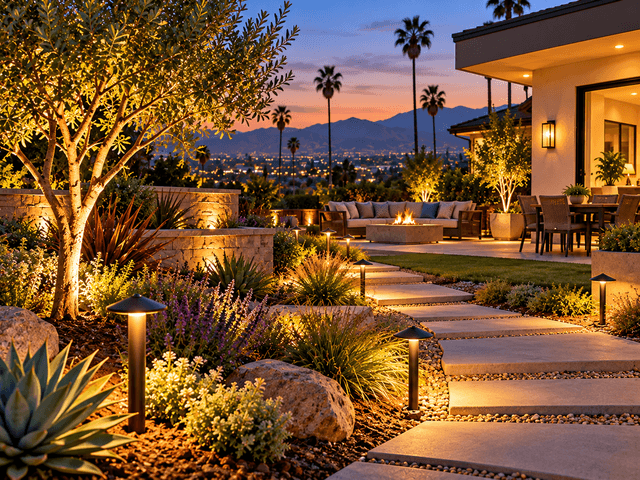
Good landscape lighting installation isn't about how many fixtures you add — it's about where and how you light, so the yard looks intentional after dark instead of spotlit. A well-designed low-voltage system layers different kinds of light (path, up, wash, accent) to shape the space, highlight the best features, and improve safety and security. What it costs depends on the design, fixture count and type, and the wiring, not a flat per-light price. Here's how landscape lighting is designed, the low-voltage basics in plain terms, what drives the cost, and why it's the finishing layer that makes a yard. This is general guidance, current as of October 2026.
What makes landscape lighting work?
Good outdoor lighting layers a few types of light for effect rather than flooding the yard: path lights for safe walkways, uplighting to show off trees and architecture, wash or "moonlighting" for soft ambient fill, and accent lighting for focal points. Most residential systems are low-voltage — a transformer steps household power down to a safe 12 volts — which is safer, flexible, and energy-efficient with LED fixtures. The cost depends on the design, number and type of fixtures, and wiring runs. A good design lights the right things, not everything.
What does landscape lighting installation involve?
A professional install starts with a lighting design — deciding what to light and how — then placing fixtures, running low-voltage cable, setting a transformer, and tuning the system so the effect looks natural at night. It's as much design as electrical work, which is why the plan matters more than the hardware. BuildCal handles this through its landscape lighting design and installation, and the right scheme depends on your yard's layout, planting, and how you use the space. For inspiration, our landscape lighting ideas for Glendale show what's possible.
Layering: the heart of good design
The difference between flat and beautiful lighting is layering several types:
- Path lighting — low fixtures that light walkways and steps for safe footing.
- Uplighting — fixtures at the base of trees, walls, or architecture, casting light upward to add drama and depth.
- Wash / moonlighting — soft, broad light (sometimes from above, through tree canopies) for gentle ambient fill.
- Accent lighting — focused light on a specimen plant, water feature, or focal point.
Combining these creates contrast and dimension, so the yard reads as designed rather than simply lit. Our guide on setting landscape lighting goals and zones covers how to plan the layers.
Low-voltage basics, in plain terms
Most residential landscape lighting is low-voltage: a transformer plugged into household power steps 120 volts down to a safe 12 volts, which then runs through buried cable to the fixtures. The advantages are safety (12 volts is far less hazardous), flexibility (fixtures are easy to add or move), and efficiency, especially with LED fixtures that sip power and last for years. The transformer is sized to the total load of the fixtures, and good design keeps the cable runs and connections sound so the lights stay reliable.
What drives the cost?
Rather than a per-fixture price, here's what moves the number — because a few accent lights and a whole-property scheme are very different projects. This framing is current as of October 2026.
- Number of fixtures. More lights mean more hardware and labor.
- Fixture type and quality. Path, up, well, and specialty fixtures vary in cost, as does build quality (which affects longevity outdoors).
- Design complexity. A layered, multi-zone scheme takes more planning than a simple path run.
- Wiring runs. Distance from the transformer, trenching, and getting cable across hardscape add labor.
- Transformer and controls. Sizing, timers, photocells, or smart controls.
- Site conditions. Mature planting, slopes, and access affect installation.
Lighting types at a glance
| Type | What it does | Best for | Notes |
|---|---|---|---|
| Path lighting | Lights walkways and steps | Safety and navigation | Spacing matters for even light |
| Uplighting | Casts light upward on features | Trees, walls, architecture | Adds drama and depth |
| Wash / moonlighting | Soft ambient fill | Overall mood | Gentle, natural effect |
| Accent | Focused light on a focal point | Specimen plants, features | Draws the eye |
| Security | Lights entries and dark corners | Safety and deterrence | Blend with the design |
Lighting for security and safety
Beyond looks, lighting makes a yard safer and more secure. Lit paths and steps prevent trips, and illuminating entries, dark corners, and side yards removes the hiding spots that make a property a target. The best security lighting is designed into the overall scheme so it protects without the harsh, floodlit look — a subtle layered approach lights what matters while keeping the yard attractive. Our guide on landscape lighting for security in SoCal covers how to balance the two.
Who typically adds landscape lighting?
Homeowners finishing a yard or renovation who want to enjoy and show it off after dark are the core audience — along with those wanting more curb appeal, safer walkways, or better security. It's common across Glendale, La Crescenta, La Cañada, and the valleys. It also suits owners of new hardscape or planting who want to highlight the investment, and HOAs or commercial properties lighting entries and common areas. Lighting is often the final layer that ties a finished landscape together.
What mistakes lead to disappointing lighting?
- Over-lighting — too many fixtures that flatten the yard instead of shaping it.
- Only path lights, with no uplighting or accents for depth.
- Cheap fixtures that corrode or fail outdoors within a season or two.
- An undersized transformer or poor connections that cause dim or failing lights.
- Harsh security floods that look stark instead of integrated.
- No plan, so the result looks random rather than designed.
What to check before starting your lighting project
- What do you most want to light — paths, trees, the facade, a feature, entries?
- Is the goal ambiance, curb appeal, security, or all three?
- Do you have existing low-voltage wiring or are you starting fresh?
- Where would a transformer go, and how far are the runs?
- Do you want timers, photocells, or smart controls?
- Are fixtures good enough quality to last outdoors in the SoCal climate?
How do you choose the right landscaping company in Glendale?
For lighting, design skill matters as much as installation. Choose a licensed landscape contractor (CSLB) who starts with a lighting plan — what to light and how to layer it — rather than just quoting a fixture count, and who uses quality fixtures built to last outdoors. Look for a clear written estimate and scope, attention to transformer sizing and wiring, and an eye for balancing beauty with security. A contractor who talks about effect and layering, not just the number of lights, is the one who'll make your yard look designed after dark.
How does BuildCal help you?
BuildCal is a licensed landscape contractor (California State License Board / CSLB) in Glendale, and we treat lighting as a design layer, not a hardware drop. We start with an on-site assessment of your yard, planting, and how you use the space, then design a layered low-voltage scheme — path, up, wash, and accent lighting, plus security where it's needed — using quality LED fixtures and a properly sized transformer. Because lighting often finishes a larger project, we can integrate it with new hardscape or planting. Our guidance on where to place outdoor lighting in Glendale reflects that approach. You get a written estimate and scope before any work begins.
Steps to request your project from BuildCal
- Share photos of your yard (ideally day and evening) and what you'd like to light.
- Schedule an on-site assessment of the layout, planting, power, and access.
- Receive a written estimate with the lighting design, scope, fixtures, and timeline.
- Approve the plan and schedule the work.
- Installation and an evening walkthrough to fine-tune the effect.
Frequently asked questions about landscape lighting installation
How much does landscape lighting installation cost?
There's no honest flat figure, because it depends on the number and type of fixtures, the design complexity, wiring runs, the transformer and controls, and your site conditions. A few accent lights is a very different project from a layered, whole-property scheme. The reliable way to know is an on-site assessment and a written estimate based on your design. Costs vary with scope and fixtures; this framing is current as of October 2026.
What is low-voltage landscape lighting?
It's the standard for residential landscape lighting: a transformer steps household 120-volt power down to a safe 12 volts, which runs through buried cable to the fixtures. The benefits are safety (12 volts is far less hazardous than line voltage), flexibility to add or move fixtures, and energy efficiency — especially with LED fixtures that use little power and last for years. The transformer is sized to the total fixture load, and good connections keep the system reliable.
What types of landscape lighting are there?
The main layers are path lighting for safe walkways, uplighting that casts light upward onto trees and architecture for drama, wash or moonlighting for soft ambient fill, and accent lighting that focuses on a feature or specimen plant. Security lighting for entries and dark corners is designed into the scheme. Combining these layers creates depth and contrast, which is what makes a yard look intentionally designed at night rather than simply lit.
Does landscape lighting improve security?
Yes. Lit paths and steps prevent trips, and illuminating entries, side yards, and dark corners removes the hiding spots that make a property a target. The key is designing security lighting into the overall scheme so it protects without the harsh, floodlit look — a layered approach lights what matters while keeping the yard attractive. Good design gets you both safety and beauty rather than forcing a trade-off between them.
Are LED landscape lights worth it?
Generally, yes. LED fixtures use far less power than older halogen lighting, last much longer, and run cool, which suits low-voltage outdoor systems well. They're the standard for quality installs now. Fixture build quality still matters — well-made LED fixtures hold up to the SoCal climate for years, while cheap ones can corrode or fail. Investing in good fixtures up front usually pays off in reliability and fewer replacements down the line.
Can you add lighting to my existing landscape?
Yes. Lighting is often added as a finishing layer to an established yard, not just during a build. We assess your existing landscape, planting, and power, then design a scheme that highlights what's already there — mature trees, hardscape, the facade — and improves safety. If you have existing low-voltage wiring, we can often work with or expand it. The written scope lays out exactly what we'd install and where.
Request your estimate today
If you want landscape lighting installation that makes your Glendale or greater Los Angeles yard look designed after dark — and safer — start with a lighting plan for your actual space. Send BuildCal a few photos of your yard to schedule an on-site assessment and get a written estimate before any work begins. Call (818) 303-1570 or request your free estimate online.
Thinking about a new outdoor space?
We’d love to hear your ideas. Let’s explore what’s possible—no pressure, just a friendly conversation.
Give us a call:
+1 (818) 303-1570
Frequently Asked Question
IS THERE A FEE FOR THE INITIAL CONSULTATION?
No, we do not charge for the initial site visit. This is your opportunity to share your ideas and vision for your landscape project, start the process of design by discussing initial ideas, pin-point any landscape problems you are having, and get a scope of the overall size of scope. Plus this gives you the opportunity to meet us, learn more about our company, and ask questions.