
OUR MISSION IS TO TAILOR FOR EACH CLIENT A BEAUTIFUL, FUNCTIONAL AND ENDURING OUTDOOR ENVIRONMENT THAT WILL PROVIDE A PLACE OF SERENITY FOR FRIENDS AND FAMILY TO APPRECIATE FOR YEARS TO COME.

BuildCal Landscape Patio Article
Which Patio Surfaces Stay Coolest Underfoot in SoCal Sun?
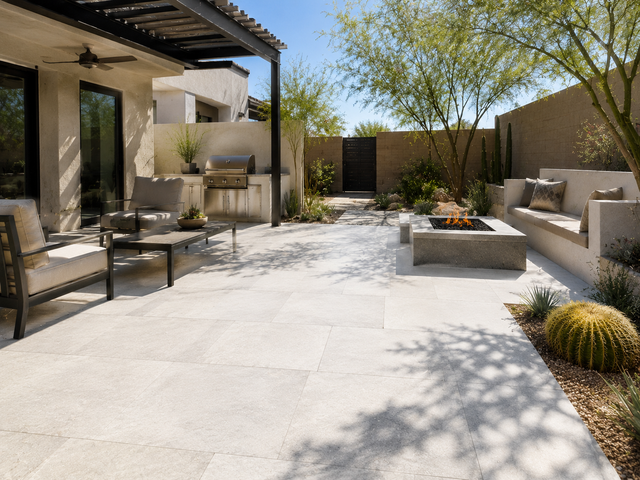
A patio can look excellent and still become unusable when the surface heats up under direct Southern California sun. If you are looking for the coolest patio surface for a hot climate, compare material color, exposure, finish, thermal behavior, and the shade around the patio—not just the product name. Light-colored pavers may be a strong starting point, but stone, concrete, porcelain, turf, and permeable systems behave differently as sun and moisture change. This guide helps you choose a surface people can actually walk on and use.
Coolest Patio Surface for a Hot Climate - Start With Exposure, Not a Shopping List
Patio surface temperature is not controlled by one property.
EPA and Berkeley Lab research on cool pavements consistently points to solar reflectance as a major factor: darker pavements absorb more incoming solar energy, while more reflective surfaces can remain cooler in the sun. But the thermal behavior of a patio also depends on how quickly the material stores heat, how it conducts heat, whether moisture is present, and whether the surface is shaded or exposed to wind.
That means a useful patio comparison has to answer more than 'pavers vs. concrete.' It should ask:
- How light or dark is the exact color you are buying?
- How much direct sun does the patio receive, and during which hours?
- Is the finish smooth, textured, porous, sealed, glazed, or heavily pigmented?
- Does the patio need to stay comfortable for bare feet, pets, children, or pool use?
- Will a pergola, tree canopy, umbrella, or roof eventually shade part of it?
- Will reflected glare or radiant heat toward seating and windows become a comfort problem?
The answer is usually a system choice, not a winner-takes-all material ranking.
What Makes a Patio Surface Heat Up?
1. Solar Reflectance: The Biggest First Filter
Solar reflectance - often called albedo - describes how much incoming solar energy a surface reflects instead of absorbing.
A higher-reflectance surface generally has less solar energy available to heat the paving. That is why light colored pavers often perform better under direct sun than the same general material in charcoal, black, deep brown, or another dark finish.
But color is a visual clue, not a laboratory value. Two products that both look 'beige' can use different aggregates, pigments, binders, and surface treatments. If heat is a top priority, ask the manufacturer or supplier whether solar reflectance, SRI, or comparable heat-performance information is available for the exact color - not just for the product line.
2. Thermal Properties: Why Material Still Matters
Reflectance is important, but the substrate also matters. Dense materials can store and conduct heat differently from more porous materials. A surface that heats slowly can still feel hot after hours of exposure. A surface that cools quickly in evening shade may be more comfortable later in the day even if its afternoon peak is high.
This is why blanket statements such as 'all stone is cool' or 'all concrete is hot' are too crude to guide a real patio choice.
3. Shade and Exposure: The Variable You Control Most
UC Davis pavement research adds an important nuance: increasing reflectance can lower the pavement surface temperature, but highly reflective surfaces can also increase the radiant energy reflected toward people. In other words, a cooler slab does not automatically mean a cooler person standing beside it.
That is why shade deserves equal billing with the paving material.
- A shaded medium-tone paver may feel more usable than an unshaded high-reflectance paver during peak afternoon sun.
- A west-facing patio may need a different strategy from a north-facing courtyard.
- A pool deck with wet bare feet has different priorities from a covered dining patio.
- A material next to large glass doors may need glare and reflected-radiation consideration, not only surface-temperature consideration.
Cool Pavers and Patio Materials- A Practical Heat Ranking
The table below is intentionally qualitative. It is a screening tool, not a promise that one material will hit a specific temperature at your property.
|
Surface Type |
Heat Tendency in Full Sun |
Barefoot Potential |
Main Watch-Out |
|
Light concrete pavers |
Often a strong cooler candidate |
Good candidate when color is pale and shade is planned |
Exact pigment, aggregate, finish and reflectance vary by product |
|
Pale natural stone |
Often a strong cooler candidate |
Can be comfortable, depending on stone and finish |
Stone species, density, finish, sealing and slip resistance vary |
|
Light porcelain pavers |
Can perform well if the exact surface is reflective/light |
Potentially good |
Dense surface; color, glaze, finish and glare still matter |
|
Standard light concrete slab |
Middle to good depending on finish |
Can work with shade and lighter finish |
Large slabs can still become hot; cracking/finish issues are separate decisions |
|
Medium-tone pavers or stone |
Middle |
Site-dependent |
May need shade during the hottest hours |
|
Dark pavers / dark stone / dark concrete |
Higher heat risk |
Weak barefoot candidate in full sun |
Dark color can absorb substantially more solar energy |
|
Artificial turf used beside or within patio zones |
High heat risk in direct sun |
Do not assume barefoot comfort |
Synthetic surfaces can reach substantially higher temperatures than living grass; product and infill matter |
|
IMPORTANT |
Light Concrete Pavers- Usually the Best Place to Start
If your priorities are heat, repairability, design flexibility, and a patio-scale installation, light concrete pavers are often the first material family worth testing.
The reason is not that pavers are magically cool. It is that pavers give you many choices in color, aggregate, texture, and pattern, so you can select a lighter surface without committing to one large monolithic slab.
The most heat-conscious approach is usually:
-
Start in the cream, sand, buff, light gray, or pale blended color families rather than the darkest options.
- Avoid choosing a dark border around the entire patio if people will regularly walk on it barefoot.
- Ask whether the exact color has solar reflectance or SRI data.
- Compare sealed and unsealed appearance if a sealer is planned; some sealers deepen color and change sheen.
- Use shade strategically over the seating and main barefoot routes.
For a broader material comparison before you narrow the color palette, see the patio paver materials guide.
A Hot Concrete Patio Is Often a Color-and-Exposure Problem Too
For a direct material comparison, review our pavers vs. concrete comparison guide.
Homeowners often search 'hot concrete patio' after discovering that the slab feels much hotter than the air.
Concrete can absolutely get hot in full sun, but the word concrete does not tell you enough. Fresh pale concrete generally reflects more solar energy than very dark paving, and Berkeley Lab research shows that concrete reflectance varies with cement, sand, aggregate, weathering, soiling, and abrasion.
A dark stain, dark integral color, or darker topping changes the equation. So does full western exposure.
If you are deciding between a slab and modular paving, use heat as one decision factor alongside cracking behavior, repairs, drainage, design flexibility, and the look you want. The existing
pavers vs. concrete comparison covers those broader tradeoffs; this article is deliberately narrower and focuses on what your feet feel in summer.
Natural Stone- 'Stone' Is Too Broad to Be a Heat Rating
Travertine, limestone, sandstone, granite, slate, and other stones are often grouped together as if they behave the same way. They do not.
A pale, porous stone can be a very different summer surface from a dense, dark stone with a heat-absorbing finish. Color alone also does not settle the issue: mineral composition, porosity, thickness, finish, moisture, and sealing can all change performance.
If you are considering natural stone for a barefoot-friendly patio, compare the exact stone and finish that will be installed. Pay particular attention to:
-
Color and reflectance in direct sun.
-
Slip resistance when wet, especially around pools.
- Surface texture under bare feet.
- Whether sealing will darken the stone.
- How the stone weathers and stains over time.
- Whether replacement pieces will be available later.
Do not buy a stone because someone calls the species 'cool.' Buy the exact finish because you have seen how it performs.
Porcelain Pavers- A Good Candidate, Not an Automatic Winner
Outdoor porcelain pavers can be attractive for heat-conscious patios because they are available in many lighter colors and consistent finishes. But porcelain is dense, and product-specific color and surface treatment matter.
A pale matte porcelain paver and a dark porcelain paver should not be assumed to behave the same way. A highly reflective finish may also create glare in an exposed courtyard.
If porcelain is on the shortlist, request the technical sheet for the exact exterior product and check slip performance as carefully as heat. Around pools or wet zones, surface grip can matter more than winning a small temperature difference.
Artificial Turf Is Not the 'Soft, Cool' Alternative People Assume
Artificial turf can solve other design problems, but heat is not automatically one of them.
A 2024 systematic review of synthetic sports surfaces found that synthetic grass surface temperatures were consistently higher than natural grass across the studies reviewed, although the size of the difference varied by construction and product. UC Cooperative Extension has also documented very high synthetic-turf surface temperatures in hot California field measurements.
That does not mean every residential turf product reaches the same temperature. It means you should not choose turf beside a pool, play zone, or barefoot path assuming that 'not concrete' equals cool.
If turf is part of the design, ask how much direct sun the exact area receives and where people will actually step. A shaded transition path may be fine; an exposed barefoot lounge route may not be the place to make assumptions.
Permeable Does Not Automatically Mean Cool When It Is Dry
Permeable paving can be valuable for drainage, but homeowners sometimes hear 'permeable' and assume it will always stay cooler.
UC Davis research shows that evaporative cooling can reduce pavement temperature when moisture is available. Under dry conditions, that effect is limited. In a water-conscious Southern California landscape, it would make little sense to design a patio that only feels cooler if you keep wetting it.
Choose permeable systems primarily because they solve drainage or stormwater goals. Treat any cooling benefit as site- and moisture-dependent rather than guaranteed.
The Shade Strategy Usually Beats the Material-Only Strategy
If barefoot comfort is a real priority, the most effective design question may be 'Where should the shade go?' rather than 'Which paver wins by a few degrees?'
Map the sun across the patio during the hours you actually use it.
1. Mark the main path from the house to seating, pool, grill, or lawn.
2. Identify the hottest afternoon exposure, especially west and southwest sun.
3. Place permanent or adjustable shade over the areas where people linger, not only over decorative corners.
4. Use the cooler material palette on the unshaded circulation zones that cannot be covered.
5. Keep very dark accent bands away from the primary barefoot route unless they will be shaded.
Pergolas, patio covers, umbrellas, trees, and other shade strategies have different structural, maintenance, permit, and seasonal effects. The right answer depends on whether you want permanent cover, winter sun, tree canopy, or flexible shade.
How to Choose a Cool, Barefoot-Friendly Patio in SoCal
The best selection process is surprisingly simple: stop comparing names and start comparing exact samples.
|
THE SAMPLE TEST |
If the supplier provides solar reflectance or SRI information, use it as another input. Do not treat marketing words such as 'cool,' 'desert,' 'pool,' or 'summer' as technical data unless the manufacturer explains the test behind the claim.
A Better Material Consultation Starts With Five Questions
Before finalizing installation details, see our paver installation guide for Glendale and confirm the site-specific build requirements.
- When will the patio be used most: morning, midday, late afternoon, or evening?
- Will people commonly be barefoot, including children or pool users?
- How much direct sun will hit the surface after the shade plan is complete?
- Is glare toward windows, seating, or neighbors a concern?
- Do drainage, slip resistance, maintenance, repairs, and style narrow the options before heat is considered?
That last question matters. The coolest-looking sample is not the right patio if it is slippery when wet, incompatible with the design, difficult to maintain, or wrong for the installation system.
Heat Is Only One Part of a Good Paver Selection
For a broader installation path, visit our hardscaping services page.
A patio material has to survive more than summer sun.
You also need to consider base preparation, joint behavior, drainage, edge restraint, traffic, furniture, food and grease exposure, pool chemicals if applicable, and future repairs.
The paver installation guide for Glendale explains why base preparation and installation details matter after the material is chosen, while the broader Hardscaping services page shows how patios relate to steps, retaining walls, walkways, seating areas, and other permanent site elements.
What Not to Do
- Do not choose the darkest surface you love indoors and assume it will feel the same outside at 3 p.m.
- Do not call a patio 'barefoot-friendly' based only on the material category.
- Do not assume all travertine, all porcelain, all concrete, or all pavers have the same thermal performance.
- Do not use artificial turf as the automatic cool alternative to hardscape.
- Do not rely on permeability for cooling unless the system actually has moisture available - and do not create a water-wasting maintenance habit just to cool the patio.
- Do not forget glare. A highly reflective surface can reduce its own temperature while still reflecting more radiation toward people or glass.
- Do not solve the entire problem with material if the patio will still sit in brutal western sun with no shade.
- Do not publish or rely on a single temperature number unless the test conditions, exact product, color, surface condition, weather, time, and measurement method are known.
The Decision Framework- Choose the Coolest Patio for Your Actual Use
|
If This Is Your Priority |
Start Here |
Then Verify |
|
Barefoot family patio |
Light concrete pavers or pale stone + shade |
Exact sample heat, texture, glare, maintenance |
|
Pool deck |
Light, slip-resistant surface + shade where people lounge |
Wet grip, barefoot feel, chemical exposure, drainage |
|
Modern minimalist patio |
Light/medium pavers or porcelain |
Glare, finish, heat, stain behavior |
|
Full-sun west-facing patio |
Shade plan first, then high-reflectance/light materials |
Late-afternoon sample exposure |
|
Covered dining patio |
Material durability/style can carry more weight |
Heat at uncovered edges and circulation routes |
|
Mixed turf + hardscape yard |
Keep barefoot routes out of hottest exposed synthetic zones |
Turf product, infill, shade, transitions |
The Goal Is Not the Lowest Lab Number. It Is a Patio People Actually Use.
A patio can be technically beautiful and still fail if everyone avoids it from noon to sunset.
For Southern California, the strongest heat strategy is usually layered: lighter surface colors, product-specific testing where available, sensible material selection, shade over the real activity zones, and a layout that keeps the hottest accents out of barefoot circulation.
That is more reliable than chasing one material that someone online called 'the coolest.'
Use the Cool-Surface Material Selector to compare color, reflectance information, shade exposure, finish, slip resistance, barefoot use, drainage, and maintenance before you approve the final patio palette.
Choose a Patio Surface People Will Actually Use
Download the Cool-Surface Material Selector to compare color, exposure, finish, shade, barefoot comfort, drainage, and maintenance before choosing a patio surface. For a property-specific plan, visit paver installation or book a consultation and call +1 (818) 303-1570.
Frequently Asked Questions
What is the coolest patio surface for a hot climate?
There is no single material that is always coolest. Light-colored, higher-reflectance concrete pavers and some pale natural stones are strong starting candidates, but the exact color, finish, material properties, sun exposure, and shade plan all matter. Compare exact samples under the same site conditions before selecting a barefoot patio surface.
Do light colored pavers stay cooler than dark pavers?
Generally, lighter and more solar-reflective paving absorbs less solar energy than darker, more absorptive paving, so it can maintain a lower surface temperature in direct sun. However, visible color is only a clue; aggregate, pigment, binder, finish, soiling, and product-specific reflectance also affect performance.
Why does my concrete patio get so hot?
Concrete exposed to strong sun absorbs solar energy and can become much hotter than the surrounding air. Dark stains, darker integral colors, long western exposure, and lack of shade can increase the problem. A lighter finish and well-placed shade can improve usability even if the patio remains concrete.
Is travertine always cooler than concrete pavers?
No. Travertine is often chosen for warm-climate patios, but stone color, density, porosity, finish, thickness, sealing, and exposure vary. A pale travertine may be a good heat candidate, but it should be compared with the exact paver colors under consideration rather than treated as automatically cooler.
Are porcelain pavers good for a barefoot-friendly patio?
They can be, especially in lighter exterior-rated colors, but porcelain is not automatically cool. Check the exact product's finish, slip resistance, glare, and heat behavior. For pool or wet areas, safe traction may be more important than a small difference in surface temperature.
Does artificial turf stay cooler than pavers?
Do not assume so. Research on synthetic grass surfaces has found higher surface temperatures than natural grass, and California field observations have documented very hot synthetic turf in direct sun. Residential products vary, but turf should be evaluated as its own heat-exposed surface rather than assumed to be a cool alternative.
Do permeable pavers stay cooler?
They can have evaporative cooling benefits when moisture is available, but that benefit is not guaranteed when the pavement is dry. In Southern California, choose permeable paving primarily for drainage or stormwater goals, then evaluate heat performance separately.
What matters more for a cool patio: the material or shade?
Both matter, but shade can dramatically change how usable a patio feels because it reduces direct solar load on both the paving and the people using it. A heat-conscious design usually combines a lighter surface with strategically placed shade instead of relying on material alone.
How should I test patio materials before installation?
Compare exact samples of the colors and finishes you are considering in the real patio location during a representative sunny period. Keep the exposure conditions the same. Manufacturer solar reflectance or SRI data can add useful context, but site-specific sample comparison helps prevent a showroom-only decision.
Thinking about a new outdoor space?
We’d love to hear your ideas. Let’s explore what’s possible—no pressure, just a friendly conversation.
Give us a call:
+1 (818) 303-1570
Frequently Asked Question
HOW CAN WE PLAN A LOW-MAINTENANCE LANDSCAPE?
There are several ways to create a lush and lasting low maintenance landscape. Such as: installing smaller planting beds, filling the property with hardy plants and border color (such as perennials), applying a 3” layer of mulch to retain moisture, picking correct plants for the existing sun exposure, soil conditions, and water availability.