
OUR MISSION IS TO TAILOR FOR EACH CLIENT A BEAUTIFUL, FUNCTIONAL AND ENDURING OUTDOOR ENVIRONMENT THAT WILL PROVIDE A PLACE OF SERENITY FOR FRIENDS AND FAMILY TO APPRECIATE FOR YEARS TO COME.

BuildCal Landscape Hardscaping & Outdoor Recreation Article
Backyard Putting Greens & Sport Courts in SoCal - Turf, Base & What They Really Take
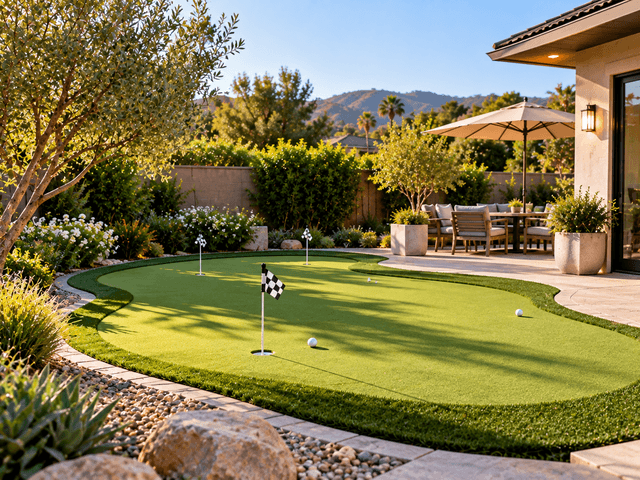
A backyard putting green looks like the ultimate luxury upgrade — practice your short game in slippers, impress everyone at the barbecue — and the first question everyone asks is whether it is actually worth the cost. Here is the honest framing: a putting green or sport court is not a rug you roll out. It is a turf surface built on a seriously engineered base, and that base is the entire difference between a green that rolls true and drains for a decade and one that puddles, settles, and sprouts weeds in two seasons. So the real question is not just whether a backyard putting green is worth the cost, but whether it is built right. This guide covers how to judge if it fits your use and space, how the base and drainage are actually constructed, how putting turf differs from sport-court turf, the cups, contours, and lighting that finish it, and what maintenance and lifespan to expect.
Is a Backyard Putting Green Worth It?
Worth is about use, not just dollars. A backyard putting green or game court backyard feature earns its place when it gets used and fits the property — and disappoints when it is squeezed into a leftover corner no one visits. Ask these questions honestly before you build.
- Use: Will you actually practice or play regularly, or is it a one-weekend novelty?
- Space: Is there enough room for a green with a realistic roll, or a court with safe run-off around the edges?
- Value to you: Does it replace a high-maintenance lawn, add family recreation, or support the way you use the yard?
- Site fit: Does the location have the sun, access, and drainage to support a quality build?
- Durability: A well-built green is low-maintenance and lasts for years, which is a big part of its long-term value compared to lawn.
For many homeowners it pairs well with a broader turf plan — our artificial turf installation guide covers the water, maintenance, and durability benefits that make recreation turf appealing in SoCal.
The Engineered Base Is What Makes It Last
If you remember one thing, make it this: the turf putting green base is the project. The green surface you see is the easy part; everything that makes it roll true, drain, and stay level is built underneath, and it is where cheap installs fail.
- Excavation: The area is dug out so there is room for a proper engineered base, not just turf laid on dirt.
- Sub-base: Layers of compacted aggregate create a firm, stable, level foundation that will not settle unevenly.
- Compaction: Each layer is compacted so the surface stays true and does not develop dips and bumps.
- Drainage: A permeable base and proper grading let water drain through and away, so the green does not puddle — the same drainage principles that protect any yard apply here.
- Edging and weed barrier: Secure edges and a weed barrier keep the turf in place and the surface clean.
This is heavy, precise construction, which is why it belongs in a hardscaping and base-engineering build rather than a quick turf drop. When evaluating installers, the same questions you would ask when choosing a hardscape contractor — about base prep, compaction, drainage, and what is included — apply directly.
Choose Putting Turf or Play Court Turf
Not all turf is the same, and the surface has to match the activity. An artificial putting green uses a specialized short, dense turf designed for a smooth, consistent roll, while a backyard sport court uses a more durable turf built to take running, pivoting, and equipment.
| Putting green turf | Sport-court / play turf | |
|---|---|---|
| Surface | Short, dense, smooth for a true roll | More durable pile for traffic and movement |
| Priority | Ball roll, speed, and consistency | Traction, resilience, and wear resistance |
| Infill | Tuned for roll and firmness | Chosen for stability and cushioning |
| Best for | A home golf green SoCal short-game practice | Family games, basketball, and multi-use play |
- Match the infill to the turf and the use so the surface performs and stays stable.
- Remember turf can get hot in direct sun; consider lighter turf, shade, and placement for comfort.
- Plan for how the green or court connects to the rest of the yard and surrounding surfaces.
Add Cups Contours Fringe and Lighting
The details are what turn a flat patch of turf into a real green or court. These finishing elements shape how it plays and how usable it is.
- Cups and holes: Multiple cups and target locations add variety and challenge to a putting green.
- Contours and breaks: Subtle slopes and undulations make putting realistic rather than flat and dull.
- Fringe and collars: A fringe border frames the green and adds a chipping area.
- Lighting: Low-glare lighting extends play into the evening and makes the space usable after dark.
- Surrounding landscape: Planting, borders, and hardscape tie the feature into the yard so it looks designed, not bolted on.
Maintenance and Lifespan of a Backyard Green
Part of the appeal is low upkeep compared to a living lawn — but "low maintenance" is not "no maintenance." A quality green or court needs light, routine care to keep performing.
- Brush the turf periodically to keep fibers upright and the roll consistent.
- Rinse off dust and debris, and clear leaves and organic matter before they break down on the surface.
- Top up and redistribute infill over time as needed.
- Check seams, edges, and drainage and address any issues early.
- Expect a well-built green on a proper base to last for years; a poor base is what shortens lifespan, not the turf alone.
Frequently Asked Backyard Putting Green Questions
How Much Space Do I Need for a Putting Green?
Enough for a realistic roll and some room around the edges — a small practice green fits a modest footprint, while a larger green with multiple cups and contours needs more. For a sport court, you also need safe run-off space around the playing area. The right size depends on how you will use it and your yard, so the best approach is a site evaluation that matches the design to your actual space rather than a fixed number.
How Is the Base for a Putting Green Built?
The turf putting green base is excavated, then built up with compacted layers of aggregate to create a firm, level, stable foundation, with permeable drainage and proper grading so water passes through and away. Secure edging and a weed barrier finish it before the turf and infill go on. This engineered base — not the turf itself — is what makes the green roll true, drain, and last, which is why base preparation is the most important part of the build.
Does an Artificial Putting Green Drain Well?
A properly built one does. Drainage is designed into the base — a permeable sub-base and correct grading let water move through the turf and base and away from the area, so the green does not puddle after rain or rinsing. A green that holds water almost always has a base or drainage problem, which is why drainage planning is part of a quality installation rather than an afterthought.
How Long Does Putting Green Turf Last?
With a properly engineered base and routine care, a quality backyard green or court can last for years of regular use. Lifespan depends far more on the base, drainage, turf quality, and maintenance than on the turf fibers alone — a premium turf on a poor base fails early, while a good turf on a solid, well-drained base holds up. Brushing, rinsing, clearing debris, and topping up infill keep it performing over time.
Plan Your Putting Green or Sport Court Today
If you are weighing whether a backyard putting green is worth the cost, the answer comes down to how you will use it and whether it is built on a base that lasts. Contact BuildCal Landscape for a putting-green or sport-court consultation or call +1 (818) 303-1570. Our hardscaping and base-engineering services can build the excavated, compacted, well-drained foundation, and our landscape services can integrate the green, turf, lighting, and surrounding planting so your Glendale or Los Angeles yard gets a green that rolls true for years.
Thinking about a new outdoor space?
We’d love to hear your ideas. Let’s explore what’s possible—no pressure, just a friendly conversation.
Give us a call:
+1 (818) 303-1570
Frequently Asked Question
HOW CAN WE PLAN A LOW-MAINTENANCE LANDSCAPE?
There are several ways to create a lush and lasting low maintenance landscape. Such as: installing smaller planting beds, filling the property with hardy plants and border color (such as perennials), applying a 3” layer of mulch to retain moisture, picking correct plants for the existing sun exposure, soil conditions, and water availability.