
OUR MISSION IS TO TAILOR FOR EACH CLIENT A BEAUTIFUL, FUNCTIONAL AND ENDURING OUTDOOR ENVIRONMENT THAT WILL PROVIDE A PLACE OF SERENITY FOR FRIENDS AND FAMILY TO APPRECIATE FOR YEARS TO COME.

BuildCal Landscape Hardscaping & Landscape Design Article
Blocking Street & Freeway Noise With Landscaping - Berms, Walls & Dense Hedges in SoCal
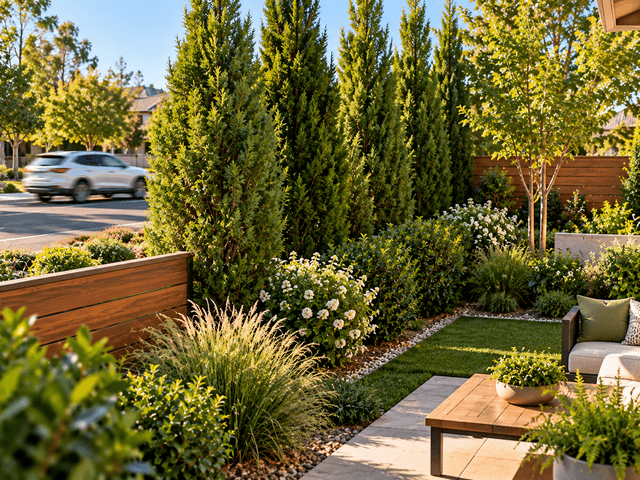
Search any SoCal neighborhood forum and you will find the same plea: "How do I block the freeway or street noise in my backyard?" — followed by a dozen confident but contradictory answers. Here is the honest version, because it saves you money: a single row of shrubs will not silence traffic. Real noise control comes from mass and continuity, and the most effective landscaping to reduce street noise layers three things — a solid barrier that physically blocks sound, dense planting that screens and softens it, and a pleasant sound source that masks whatever gets through. Plants alone mostly change how loud the yard feels rather than how loud it measures, which is still valuable but is not the whole answer. This guide explains how outdoor noise actually behaves, why walls and berms do the heavy lifting, where hedges genuinely help, and how to set realistic expectations for a yard near a busy street or freeway.
How Outdoor Noise Actually Works in a Yard
Before spending a dollar, it helps to understand the physics, because it determines what actually works. Sound is energy, and reducing it outdoors comes down to blocking, absorbing, and masking it.
- Mass blocks sound. Heavy, solid, continuous barriers — masonry walls, earth berms, solid fences — reflect and block sound energy. This is where real reduction comes from.
- Gaps leak sound. A barrier is only as good as its weakest point; sound slips through gaps, under fences, and around short walls.
- Line of sight matters. A barrier works best when it breaks the direct line of sight between the noise source and where you sit.
- Plants mostly soften and mask. A thin hedge does little to measurable noise, but a wide, dense band of planting provides modest attenuation, rustling sound, and the psychological benefit of not seeing the road.
- Masking changes perception. A pleasant sound like water makes residual traffic noise less noticeable even though the traffic is still there.
| Approach | What it does | Honest effect |
|---|---|---|
| Solid wall or berm | Blocks and reflects sound with mass | The real noise reducer — most effective when tall, long, and gap-free |
| Dense hedges / wide planting | Screens the view, softens and scatters sound | Helps perception and modestly attenuates; not a true barrier alone |
| Water feature | Adds pleasant sound that masks traffic | Changes how loud it feels, not how loud it measures |
| Thin single row of shrubs | Light visual screen | Minimal real noise reduction — the common myth |
Solid Walls and Berms Block Real Noise
If you want measurable reduction, the heavy lifting is done by mass. A sound barrier wall — a solid masonry wall, or an earth berm, or a combination — blocks sound in a way plants simply cannot. The three things that make it work are height, length, and continuity.
- Make it tall enough to break the line of sight between the noise source and your seating area.
- Make it long enough that sound does not simply travel around the ends.
- Make it solid and continuous — a solid fence with no gaps (board-on-board or solid panels) performs far better than an open or gappy one, and masonry performs better still.
- Consider a berm for noise where there is room — a landscaped earth mound adds mass and height, and a wall built on top of a berm reaches more height within rules.
- Build it properly; a tall wall or berm needs correct footings, drainage, and structure, which is where our hardscaping and wall services come in.
- Confirm local height and permit requirements before building, since taller walls and berms often need a permit.
Dense Hedges Soften and Screen the Rest
Hedges are not a true sound barrier on their own, but used correctly as a second layer they add real value. The key is "dense" and, ideally, "wide" — and some plants are specifically suited to this role. Certain dense evergreen hedges that also serve as sound barriers and wind protection are the ones to reach for.
- Use dense, evergreen species so the screen works year-round.
- Make the planting band as wide as space allows; a deep belt of vegetation does more than a thin line.
- Pair the hedge with the solid barrier — the wall blocks, the hedge softens and hides the source.
- Layer heights with a fence-plus-planting approach, using taller trees behind a hedge and a solid barrier in front.
Add Water to Mask What Remains
Even a great wall-and-hedge combination rarely eliminates traffic noise entirely. This is where masking finishes the job: a water feature introduces a pleasant, steady sound that covers residual road noise, so the yard feels calmer than the measurements alone would suggest.
- Use a fountain, bubbler, or recirculating feature near the seating area where you want quiet.
- Match the water sound to the space — enough to mask traffic without being overwhelming.
- Keep the feature recirculating and low-water, and screen or cover it so it does not become mosquito habitat.
- Remember masking changes perception, not measured decibels — it works best alongside the barrier, not instead of it.
Place the Barrier to Break the Sightline
Where you put the barrier matters as much as what it is made of. A noise barrier is most effective when it is close to the source or close to the listener and tall enough to block the direct path of the sound.
- Position the solid barrier between the noise source and your main seating or living area.
- Prioritize the specific zones you use — a patio, outdoor kitchen, or bedroom window — rather than trying to wall off the entire lot equally.
- Close gaps under gates, between panels, and at the ends where sound sneaks around.
- Combine the wall or berm, the dense planting layer, and the water feature into one layered plan for the best real-world result.
Frequently Asked Yard Noise Reduction Questions
Do Hedges Actually Block Street Noise?
Not on their own, not much. A thin row of shrubs provides little measurable noise reduction — that is a common myth. A wide, dense band of evergreen planting does more, offering modest attenuation plus the psychological benefit of hiding the road and adding rustling sound. The most effective use of hedges to block noise is as a second layer in front of or behind a solid wall or berm, which does the real blocking.
Should I Build a Wall or a Berm?
Both work because both add mass. A solid masonry wall blocks sound in a compact footprint, while an earth berm uses space but adds height and mass naturally and can be planted. The strongest solution is often a combination — a wall built on a berm reaches more effective height — plus dense planting. The right choice depends on your available space, grade, budget, and local height and permit rules.
How Tall Does a Noise Barrier Need to Be?
Tall enough to break the direct line of sight between the noise source and where you sit — the barrier has to interrupt the sound's path to be effective, and it must be continuous with no gaps. Height, length, and solidity all matter together. Because the height needed often exceeds standard fence limits, a taller wall or berm may require a permit, so confirm local height and permit requirements before you design it.
Does a Water Feature Help With Traffic Noise?
Yes, but through masking rather than blocking. A fountain or recirculating water feature adds a pleasant, steady sound that covers residual traffic noise, making the yard feel noticeably quieter even though the traffic is still there. It works best as the finishing layer alongside a solid barrier and dense planting — not as a substitute for them — and should be designed to stay low-water and mosquito-free.
Get a Noise-Reduction Design Today
If you want landscaping to reduce street noise that actually works — not a row of shrubs that disappoints — the answer is a layered plan of barrier, planting, and masking built for your specific lot. Contact BuildCal Landscape for a noise-reduction design consultation or call +1 (818) 303-1570. Our hardscaping and wall services can build the solid barrier or berm, and our landscape and planting services can add the dense screening and water masking so your Glendale or Los Angeles yard near a busy street or freeway finally feels quiet.
Thinking about a new outdoor space?
We’d love to hear your ideas. Let’s explore what’s possible—no pressure, just a friendly conversation.
Give us a call:
+1 (818) 303-1570
Frequently Asked Question
WHY DO I NEED TO HIRE A LICENSED CONTRACTOR WHEN AN UNLICENSED ONE MAY BE CHEAPER?
There is always a price. Working with a licensed contractor is highly recommended for many reasons: A licensed and insured contractor offers many protections to the property owner, especially regarding residential properties. A contractor cannot obtain a State Contractors License without first possessing a minimum amount of experience. In addition, the contractor must pass a business management test. The applicant also may be subject to a criminal history background check, and must not have any unresolved contracting complaints outstanding. Here in California, if a contractor has employees, they're required to carry workers compensation insurance. The importance of this alone cannot be overstated. If a worker is injured on your property and the contractor doesn't have insurance, you could be legally liable to pay for injuries and rehabilitation. Your homeowner's insurance may not cover those costs