
OUR MISSION IS TO TAILOR FOR EACH CLIENT A BEAUTIFUL, FUNCTIONAL AND ENDURING OUTDOOR ENVIRONMENT THAT WILL PROVIDE A PLACE OF SERENITY FOR FRIENDS AND FAMILY TO APPRECIATE FOR YEARS TO COME.

BuildCal Landscape Landscape Design Article
Front-Yard First Impressions - The Upgrades That Actually Lift Curb Appeal in SoCal
QUICK ANSWER
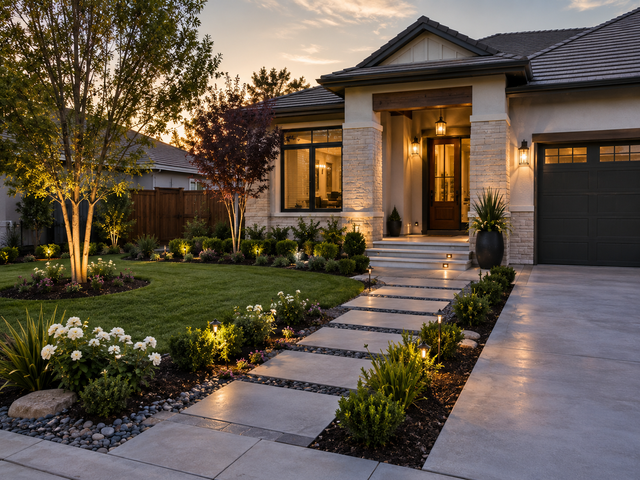
Prioritize the front yard in this order: 1) make the entry route obvious and comfortable, 2) clean up geometry and edges, 3) add a few structural plants that frame the house, 4) use restrained outdoor lighting to support the entry after dark, 5) simplify thirsty or patchy planting into a water-smart ground plane, and 6) spend on secondary decoration only after the visual structure works. This is an impact-per-scope ranking, not a guaranteed financial ROI calculation.
A front yard does not need more of everything to create a stronger first impression. It needs the right things in the right order. The common mistake is spending a weekend adding flowers, pots, and accents while the entry route, edges, and planting structure stay unresolved, so the yard still reads as busy rather than composed. If you are comparing front yard curb appeal upgrades, start instead with the sequence a visitor actually experiences: the arrival route, the front door, the clean edges, the structural plants, and the small details that make a property feel cared for. A few well-placed structural improvements can outperform a cart full of random additions, especially when the design also accounts for drought, lighting, budget, and resale presentation. This guide ranks the moves by visible impact and practical scope so you spend effort where it shows most.
Rank Front Yard Curb Appeal Upgrades by Priority
The biggest mistake in curb appeal on a budget is treating every visible problem as equally important. They are not. A cracked or confusing entry route can undermine a beautiful planting plan. A perfectly edged bed can still feel weak if the front door is visually lost. New flowers can look temporary if the permanent structure of the yard is unresolved. A better approach is to rank upgrades by how much of the first impression they control.
| Priority | Upgrade | Why It Has Leverage | Do This Before |
|---|---|---|---|
| 1 | Entry walkway and arrival | Controls movement, orientation, and the visual pull toward the front door | Decorative planting and accent features |
| 2 | Clean geometry and edges | Makes the whole yard read as maintained and intentional | Adding more plant varieties |
| 3 | Structural planting | Frames architecture and creates year-round composition | Seasonal color and small fillers |
| 4 | Outdoor lighting | Extends the first impression after dark and clarifies the route | Decorative lighting effects |
| 5 | Water-smart ground plane and irrigation | Improves consistency, maintenance, and long-term appearance | High-maintenance ornamental additions |
| 6 | Secondary accents | Adds personality once the main composition already works | Nothing — this is the finishing layer |
Make the Front Door Easy to Find First
A strong house exterior first impression begins with orientation. People should not have to visually negotiate the yard to understand how to reach the front door. The driveway, sidewalk, walkway, porch, planting, and lighting should work together like one sentence. An entry walkway upgrade often has more impact than adding another bed because it changes both how the yard looks and how it functions. Our front yard landscaping ideas for Glendale homes are a useful reference before you change the whole yard. Look for these common problems:
- The walkway is visually weaker than the driveway, so the car route dominates the front elevation.
- Shrubs narrow the usable walking width or hide the first few feet of the path.
- A series of small jogs makes the route feel accidental rather than intentional.
- The walk reaches the porch at an awkward angle or leaves guests unsure which door is primary.
- Steps appear suddenly without lighting or visual contrast.
- The paving material is visually disconnected from the home's architecture and other hardscape.
The fix does not always mean replacing the entire walkway. Sometimes the higher-impact move is widening a pinch point, improving the transition from sidewalk to path, correcting a damaged landing, simplifying the edge, or strengthening the planting and light around the route.
The Entry Route Should Feel More Important Than the Driveway
Many Southern California homes give most of the front-yard square footage to the driveway. That does not mean the driveway should become the visual focal point. Use the pedestrian route to re-establish the hierarchy.
- Give the walkway a clear beginning at the sidewalk or driveway edge.
- Use planting to frame, not squeeze, the path.
- Repeat one paving color, border, or texture so the route feels deliberate.
- Create a small pause at the porch or entry landing instead of forcing people directly into the door swing.
- Keep trash bins, hoses, utility clutter, and storage out of the primary arrival view where practical.
Clean Edges Before You Add More Plants
One of the fastest ways a front yard loses curb appeal is visual drift. The bed edge moves in and out. Gravel spills into the walkway. Mulch is thin in one zone and piled high in another. Three small planting islands compete with each other. The turf line has no relationship to the house or path. Clean geometry gives the eye fewer decisions to make. That does not mean every yard needs rigid rectangles. Curves can work beautifully. The point is consistency.
THE EDGE TEST
Stand across the street and ignore the individual plants. Look only at the shapes of the lawn, planting beds, walkway, driveway, and open ground. If those large shapes feel accidental, buying more plants will not solve the composition.
What Clean Geometry Looks Like in Practice
- One or two intentional planting masses instead of many tiny disconnected beds.
- A defined relationship between planting and the walkway.
- Mulch, gravel, or groundcover contained where it belongs, which is easier once you have chosen between decomposed granite, gravel, and pavers for the ground surface.
- No dead strips of soil trapped between paving and planting.
- A clear visual base around the house without plants crowding vents, windows, steps, or the entry.
- A front edge that can actually be maintained without constant hand-trimming.
This is where curb appeal on a budget can be surprisingly effective: removing clutter and clarifying the geometry can have more visual impact than adding material.
Use Fewer Stronger Plants to Frame the House
Front yards often become busy because every empty spot is treated as a place that needs another plant. A stronger design usually does the opposite. Start with structural plants — the trees, large shrubs, repeated medium shrubs, or architectural grasses that define the composition from the street. Then use smaller plants as a supporting layer. The goal is not botanical variety. The goal is visual order.
- Frame the entry without creating a tunnel.
- Keep important windows and architectural details visible.
- Repeat plant forms or species so the yard feels related from one side to the other.
- Use mature size, not nursery-pot size, to decide spacing.
- Keep thorny, messy, or high-maintenance species away from the primary walkway when practical.
- Choose plants for the actual sun, soil, irrigation, and microclimate rather than for the label photo alone.
If you want candidates that stay tidy with less work, the best low-maintenance plants for a Glendale garden are a useful starting point for building the structural palette.
Structural Plants Beat a Border of Small Color
Seasonal flowers can be attractive, but they are a weak foundation for a front-yard makeover. When the structural layer is right, seasonal color becomes optional. When the structural layer is wrong, seasonal color has to work too hard. Think in layers:
- Canopy or vertical anchor: a tree or architectural element that gives scale.
- Structural shrub layer: repeated forms that frame the house and entry.
- Low transition layer: groundcovers, grasses, or lower shrubs that soften edges without hiding them.
- Seasonal accent: limited color placed where the eye naturally pauses, such as near the entry.
Light the Route Not the Whole Property
Outdoor lighting can improve curb appeal because it changes what the front yard communicates after sunset. The mistake is assuming more brightness equals a more premium look. A front yard usually looks better when lighting has a job:
- Clarify the route from sidewalk or driveway to the door.
- Reveal steps, grade changes, and walkway edges.
- Gently identify the front door or porch.
- Use one or two trees or architectural elements as accents rather than lighting every plant.
- Avoid glare into guests' eyes, neighboring properties, or the street.
The best night-time hierarchy mirrors the daytime hierarchy: entry first, route second, structure third, accents last. For fixture placement and glare-control ideas, see our guide to landscape lighting for safety and curb appeal.
Why Lighting Belongs After the Geometry Is Solved
Lighting cannot rescue a confusing layout. It only makes the confusing layout visible at night. Finalize the walkway, steps, planting masses, tree locations, and main focal point first. Then place fixtures to support that composition. This sequencing also helps avoid a common rework problem: installing lights first, then moving or enlarging planting beds later.
Make Front Yard Drought Design Look Designed
For a coordinated front-yard plan, visit our landscape design services page. A front yard drought design should not look like a lawn that was removed and never replaced with a composition. Water-smart landscaping works best when it has structure. Current EPA WaterSense guidance emphasizes matching plants to climate and site conditions, supporting soil health, grouping the landscape around actual use, and using efficient irrigation where irrigation is needed. California DWR similarly emphasizes climate-adapted plants, soil, high-efficiency irrigation, and watering schedules matched to plant needs. That supports a simple curb-appeal principle: reduce thirsty or failing elements, but replace them with an intentional ground plane.
- Use repeated low-water plants rather than one of everything, drawing from regionally appropriate drought-tolerant plants for Glendale.
- Keep enough open space that each mature plant can read clearly.
- Use mulch or another appropriate ground treatment consistently.
- Preserve functional turf only where it has a real use and can be maintained well.
- Group plants with similar water needs so the irrigation system can support the design instead of fighting it.
- Do not use decorative gravel as the entire design simply because it does not need irrigation.
WATER-SMART DOES NOT MEAN EMPTY
EPA WaterSense explicitly notes that attractive landscapes can combine shrubs, trees, functional turf where useful, permeable areas, and regionally appropriate planting. The goal is a beautiful landscape matched to climate and use — not a yard stripped down to bare rock.
Water Efficiency Is Part of the Design Brief
For larger new or rehabilitated landscapes, California's Model Water Efficient Landscape Ordinance framework can apply through local agencies. The current DWR program focuses on efficient landscape design, climate-adapted plants, healthy soil, irrigation efficiency, and appropriate scheduling. Not every front-yard refresh triggers the same requirements, and local agencies can adopt ordinances that are at least as effective as the state model. The homeowner takeaway is not to memorize a statewide threshold from an article. It is to make water use, irrigation zones, soil, and plant selection part of the design conversation before the yard is rebuilt.
Fix the Small Details That Look Neglected
Once the main hierarchy works, small defects become worth fixing because they are no longer competing with bigger problems. Walk the front yard and look for visual friction:
- A hose or irrigation line crossing visible paving.
- Utility lids sitting proud of grade.
- A leaning mailbox or address marker.
- Mismatched pots clustered near the door.
- Weeds or volunteer growth at wall and paving edges.
- Dead or undersized plants that break an otherwise repeated planting rhythm.
- Overgrown shrubs hiding windows, address numbers, or porch details.
- Staining from irrigation overspray on walls, fences, or paving.
- Landscape lights tilted in different directions.
These are finishing tasks, not the starting point. Fixing them first can make a neglected yard look slightly tidier while leaving the underlying composition unchanged.
Coordinate the Landscape With the House Exterior
The landscape should support the house, not compete with it. You do not need to turn a landscape project into a full exterior renovation to improve first impression. But you should coordinate obvious touchpoints: door color, porch material, address numbers, railing, exterior lighting, visible downspouts, and the color temperature of the hardscape. A new pale walkway next to a dark modern facade reads differently from the same walkway next to warm stucco and terracotta. Plant color and foliage texture also interact with the exterior palette. The practical move is coordination. Decide which existing architectural elements are staying, then design the landscape to make those elements look intentional.
Use the Front-Yard Impact-per-Scope Scorecard
The table below is not a financial-return guarantee. It is a way to rank where visible effort usually has the strongest effect on the first impression.
| Upgrade | Visual Impact | Scope / Disruption | Maintenance Effect | Priority |
|---|---|---|---|---|
| Clarify or improve entry walkway | Very high | Low to high depending on replacement | Usually improves daily usability | Do early |
| Simplify bed geometry and edging | High | Low to medium | Often reduces visual maintenance | Do early |
| Add or reorganize structural planting | High | Medium | Depends on species and irrigation | Do early |
| Outdoor lighting focused on entry | Medium-high at night | Low to medium | Low when the system is well planned | After layout |
| Convert failing lawn to water-smart composition | High when lawn dominates view | Medium-high | Can reduce irrigation and maintenance | When lawn is a real problem |
| Seasonal flowers and small décor | Low-medium | Low | Adds recurring upkeep | Finish last |
| Full hardscape replacement for cosmetic reasons only | Variable | High | Depends on material | Only when condition or design justifies it |
Build Curb Appeal in Layers Not Random Weekends
If you are not rebuilding the entire front yard at once, use a sequence that protects earlier work.
- Remove dead, broken, or clearly misplaced elements so you can see the real layout.
- Decide whether the entry route and main hardscape are staying.
- Correct bed geometry, major drainage issues, and irrigation conflicts before new planting.
- Install the structural plant layer.
- Finish the ground plane with mulch, groundcover, appropriate turf, or another intentional surface.
- Add outdoor lighting after the planting and walkway locations are fixed.
- Use seasonal color, pots, and décor as the final layer.
That order keeps you from installing plants that later have to move for a walkway, or placing lighting where a mature shrub will eventually block it.
For Resale Avoid the Most Personal Yard Choices
A pride-of-ownership front yard can be highly personal. A resale-oriented front yard usually benefits from a little more restraint. You do not have to make the property generic. You do want the permanent decisions to be easy to understand.
- A clear path beats an artistic path that feels awkward to walk.
- Healthy repeated planting beats a collection of unusual species with different maintenance needs.
- A functioning irrigation plan beats lush planting that only looks good under constant hand watering.
- Clean, repairable hardscape beats decorative complexity that makes future repairs difficult.
- Balanced privacy beats vegetation that hides the house entirely.
The goal is a front yard that looks cared for and coherent before a visitor has to study it.
Common Front Yard Curb Appeal Mistakes to Avoid
- Do not start with decorative accessories when the walkway, bed geometry, or planting structure is still weak.
- Do not use tiny nursery plants to create a pattern that only works before they reach mature size.
- Do not plant shrubs so close to the walkway that routine growth will narrow the path.
- Do not replace a failing lawn with a field of decorative rock and assume the result automatically has curb appeal.
- Do not use outdoor lighting as a brightness contest. Glare can make a front yard feel harsher and less readable.
- Do not hide the address, front door, windows, steps, or important architectural lines behind overgrown planting.
- Do not let irrigation overspray become a permanent maintenance problem on paving and walls.
- Do not rely on a guaranteed resale-return percentage for a landscape upgrade without property-specific evidence. Curb appeal is real, but financial outcomes depend on the house, buyer, market, condition, and scope.
Run the Quick 30-Second Street Test
Before approving a front-yard plan, stand where a visitor first sees the property and answer these questions quickly:
- Where does my eye go first?
- Is the front door obvious?
- Is the walkway easy to understand?
- Do the lawn, beds, walkway, and driveway form clean large shapes?
- Are there one or two strong planting anchors, or twenty competing details?
- Does anything look visibly thirsty, dead, stained, crooked, or improvised?
- At night, can I read the route without seeing glare?
- If all seasonal flowers disappeared tomorrow, would the front yard still look designed?
If the last answer is no, the yard probably needs stronger permanent structure before more decoration.
Build the First Impression From the Ground Up
The strongest front yard curb appeal upgrades are rarely the ones with the longest shopping list. They create a clear arrival, disciplined geometry, a few confident plants, comfortable night visibility, and a water-smart landscape that looks intentional instead of stripped down. That is the difference between a front yard that is merely maintained and one that feels composed.
Prioritize the First Impression Before You Add More
Rank the entry route, walkway, lighting, edges, plants, drought design, maintenance, and resale presentation before you set the next project scope. For a property-specific plan, visit our landscape design services or book a consultation and call +1 (818) 303-1570.
Frequently Asked Front Yard Curb Appeal Questions
What Front Yard Curb Appeal Upgrades Should I Do First?
Start with the arrival sequence: make the front door easy to find, correct a confusing or damaged entry walkway, and clean up the large shapes of the lawn and planting beds. Then add or reorganize structural plants, improve outdoor lighting, and address drought or irrigation problems. Decorative accents should come after the permanent visual structure works.
How Do I Improve Curb Appeal on a Budget?
Remove dead or misplaced elements, simplify bed edges, prune plants that hide the architecture, repair obvious walkway defects, refresh the ground plane, and focus new planting around a few repeated structural forms. Work in a sequence so you do not install planting or lighting that later has to move for hardscape.
Is an Entry Walkway Upgrade Worth Doing for Curb Appeal?
It can have unusually high visual leverage because the walkway controls both movement and the eye's route toward the front door. If the existing path is narrow, confusing, damaged, visually weak next to the driveway, or poorly connected to the porch, improving it can change the entire first impression.
What Makes a Good Front Yard Makeover in SoCal?
A strong front yard makeover in SoCal balances clear entry circulation, water-smart planting, clean edges, appropriate shade and sun exposure, efficient irrigation, and a restrained material palette. The design should look intentional in dry summer conditions rather than depending on short-lived seasonal color.
Does Drought-Tolerant Landscaping Hurt Curb Appeal?
No. Water-efficient landscaping can be highly attractive when it uses clear structure, repeated plants, healthy soil, consistent mulch or groundcover, and appropriate irrigation. EPA WaterSense and California DWR both support climate-appropriate planting and efficient irrigation as parts of attractive water-smart landscapes. The weak result comes from removing a lawn without replacing it with a coherent design.
Should I Remove My Front Lawn for Curb Appeal?
Only if the lawn is failing, excessively water-dependent for your goals, or occupying space that could function better another way. A healthy functional lawn can still be part of a water-smart landscape. If turf is removed, replace it with a designed composition rather than leaving an empty gravel field.
How Much Lighting Should a Front Yard Have?
Enough to make the entry, walkway, steps, and a few important features readable after dark without creating glare. The goal is hierarchy, not maximum brightness. Finish the walkway and planting layout first, then place fixtures to support those elements.
What Plants Give the Biggest Curb Appeal Impact?
Usually the plants that create structure: an appropriately scaled tree, repeated shrubs, architectural grasses, or low masses that frame the entry and architecture. The exact species should match the property's sun, soil, mature-space limits, irrigation, and climate. A small number of repeated, healthy plants often has more visual impact than a large mixed collection.
What Front Yard Changes Should I Avoid Before Selling?
Avoid highly personal permanent features that make circulation awkward, difficult-to-maintain planting combinations, major decorative hardscape changes without a functional reason, or upgrades that hide the entry and architecture. Resale-oriented curb appeal usually benefits from clarity, maintenance, healthy planting, and a front route that is easy to understand.
Can Landscaping Guarantee a Higher Resale Price?
No. Landscaping can improve condition and first impression, but no front-yard upgrade can guarantee a specific resale increase. Sale outcomes depend on the property, market, buyer preferences, overall condition, and many factors beyond the landscape. Use curb-appeal upgrades to improve presentation and usability rather than relying on a universal ROI percentage.
Thinking about a new outdoor space?
We’d love to hear your ideas. Let’s explore what’s possible—no pressure, just a friendly conversation.
Give us a call:
+1 (818) 303-1570
Frequently Asked Question
CAN YOU GIVE ME AN ESTIMATE FOR MY PROJECT DURING THE INITIAL CONSULTATION?
No, Too often a landscape contractor will come to a site and immediately give a potential client a price without first knowing all the details of that project. Our first question is always, “What is this estimate based on?” Before making out a bid of any sort, we must first discuss all the work to be done, the planting and construction materials necessary, and the labor involved. After which we do a breakdown and present to you a complete and itemized preliminary estimate. As our client you will be able to see, not only how much your project will cost, but also where every dollar will go.