
OUR MISSION IS TO TAILOR FOR EACH CLIENT A BEAUTIFUL, FUNCTIONAL AND ENDURING OUTDOOR ENVIRONMENT THAT WILL PROVIDE A PLACE OF SERENITY FOR FRIENDS AND FAMILY TO APPRECIATE FOR YEARS TO COME.

BuildCal Landscape Hardscaping Article
Decomposed Granite vs. Gravel vs. Pavers for SoCal Yards Mud, Weeds & Upkeep, Honestly
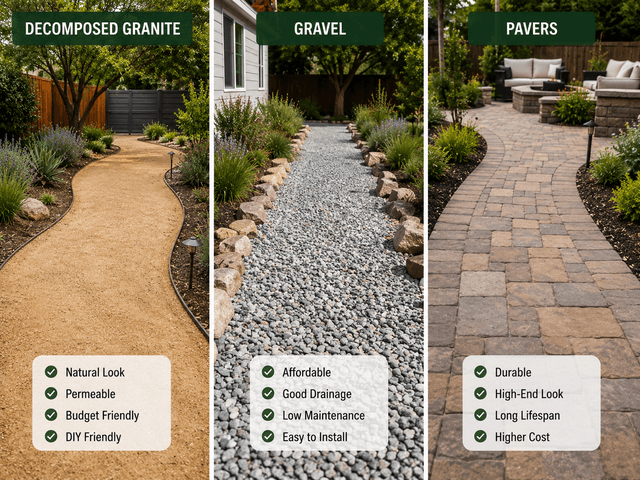
Every SoCal homeowner rethinking their yard eventually lands on the same three surfaces: decomposed granite, loose gravel, and pavers. The pretty photos on Pinterest make all three look great. The honest daily reality is more mixed. Each has real strengths, each has trade-offs you'll live with for years, and matching the right one to the right spot is what separates a yard that ages beautifully from one you'll be regravelling every summer.
This is the honest decomposed granite vs gravel vs pavers comparison - what each is genuinely great at, where each falls short, and how to choose. If you're specifically weighing DG against pavers, our two-way piece on decomposed granite vs pavers goes deeper on those two; if you want the full three-way picture including loose gravel, keep reading. For hardscape design and installation, see our paver installation services.
Quick Answer, Then the Honest Detail
If you want the three-line summary before the deep dive:
- Decomposed granite (DG): best for garden paths, seat-out areas, and casual side yards. Natural look, low-water and permeable, but tracks into the house, gets muddy when wet, and needs periodic top-ups.
- Loose gravel: best for dry drainage strips, side paths, and utility zones. Cheapest, most permeable, but noisy, unstable underfoot, weedy, and hard to walk on with heels or a stroller.
- Pavers: best for main patios, walkways, driveways, and anything you'll use daily. Highest upfront investment and least permeable, but most durable, easiest to live with, and the surface that ages best.
The rest of the article expands each one honestly, then closes with a match-your-surface-to-your-use decision framework.
Decomposed Granite (DG)
DG is finely crushed granite - somewhere between coarse sand and small gravel - that compacts into a firm, natural-looking surface when installed correctly. It's especially popular as part of a lawn-swap in SoCal because it looks earthy, drains well, and reads as low-water landscaping.
What DG Is Great At?
- Natural, warm, garden-appropriate look that pairs beautifully with drought-tolerant planting and Mediterranean palettes.
- Permeable - water percolates through instead of running off, which helps with drainage and is friendly to trees.
- Comfortable underfoot and cool on hot days compared with concrete or dark pavers.
- Softens the space visually the way hard hardscape doesn't.
- Genuinely low-water, and a good middle path between plastic turf and bare gravel.
The Honest Downsides
Decomposed granite problems are consistent enough that they show up in nearly every lawn-swap thread. The main ones:
- Tracking. DG dust and small particles follow you into the house, onto pool decks, and onto adjoining hardscape. A rug or shoe change at the door helps but doesn't eliminate it.
- Mud when wet. A hard rain can turn a DG surface pasty and print with footprints. Fines can wash out of the mix, sometimes onto adjacent patios or into drains.
- Ruts and low spots. Furniture legs, dog paths, and repeated foot traffic create ruts that need raking and refilling. Wheelbarrows, strollers, and heels struggle on soft DG.
- Weeds. Without proper edging, base prep, and either a stabilizer or occasional refresh, weeds establish along edges and in bare patches.
- Periodic top-up. Even a well-built DG surface loses material over years and needs occasional re-application.
How to Make DG Work?
The DG surfaces you'll be happy with a decade in were built with discipline: proper subgrade preparation, adequate depth (three inches or more), compaction in lifts, defined edges (steel, stone, or a border) to keep material in place, and often a resin or polymer stabilizer for high-traffic spots. Without those, the trade-offs above show up fast. See our related notes on hardscape materials for local conditions and on walkway design for the disciplines that make a DG pathway last.
Best For
- Meditation paths, secondary garden paths, casual seating areas away from the house entry.
- Around ornamental beds and Mediterranean-style plantings.
- Under mature trees where permeability matters.
Not ideal for: main patios, high-traffic walkways to the front door, pool decks, driveways, or anywhere directly adjacent to interiors that'll suffer from tracking.
Loose Gravel
Loose gravel means rounded river rock, angular crushed rock, or pea gravel installed without a binder - the classic "drainage rock" or "gravel yard" surface. It's the cheapest of the three and the most permeable, which is why it turns up so often in lawn removals.
What Loose Gravel Is Great At?
-
Extremely permeable - water goes straight through, which helps with drainage.
- Doesn't compact into mud when wet the way DG can - the individual stones shed water.
- Very low cost to install and easy to top up.
- Distinctive crunch and texture in the right design context.
- Works well as functional infrastructure: dry drainage strips, French-drain caps, utility paths, and side-yard access.
The Honest Downsides
The gravel yard tracking issue is the least of it. The real downsides are underfoot:
- Unstable to walk on. Especially rounded river rock - it rolls under your foot. Difficult for kids, seniors, guests in heels, wheelchairs, and strollers.
- Migrates. Loose stones travel outside their edging with foot traffic, mowers, and blowers. They end up in adjacent planting beds, lawns, and sidewalks.
- Noisy. Some people love the crunch; others find it intrusive. Pets and kids running across it are loud.
- Weedy. Weeds find their way through gravel readily. Fabric underneath helps for a while, then breaks down or gets penetrated - and reinstalling means moving all the stone.
- Uninviting to bare feet, pets. Angular gravel especially is hard on paws and impossible to lie on.
- Not code-friendly for main access paths. An accessible route to a front door usually can't be loose gravel.
How to Make Gravel Work?
Gravel behaves best when it's used honestly - as an infrastructure surface rather than pretending to be a patio. Use defined edging (steel, timber, stone), a proper base with weed-suppressing fabric, and pick the right stone (angular crushed rock is more stable underfoot than rounded river rock, though harder on bare feet). Use gravel where its permeability is the whole point.
Best For
- Dry drainage strips along fences, foundations, or beds.
- Side yards and utility zones you walk through occasionally.
- Around downspout outlets, under gates, or as capping for French drains.
- Under fire pits or as a defined ornamental feature within a larger design.
Not ideal for: main patios, walkways to the front door, pool decks, driveways, kids' play areas, or barefoot zones.
Pavers
Pavers - modular concrete, natural stone, or clay units laid on a compacted base with sand joints - are the durable, formal end of this three-way. Installed properly, a paver surface is the closest thing to a set-and-forget ground surface a residential yard can have.
What Pavers Are Great At?
- Durability - a well-built paver patio or walkway lasts decades with minimal upkeep.
- Truly usable surface: level, stable, easy for furniture, strollers, wheelchairs, heels, and kids.
- Won't rut, migrate, or turn muddy in rain.
- Enormous design range - color, texture, size, and pattern give real design freedom. See our overview of paver patterns and our paver materials selection guide.
- Permeable options exist. Interlocking permeable paver systems combine the durability of pavers with drainage more like gravel. See our note on permeable driveway pavers.
- Repairable in place - a settled or stained unit can be lifted and replaced without redoing the whole surface, unlike stamped concrete.
The Honest Downsides
-
Highest upfront investment of the three, primarily due to the excavation, base preparation, and labor required to build them right.
- Least permeable of the three unless you specifically choose a permeable system - solid pavers with sand joints let water through slowly, but not like DG or gravel.
- Installation quality matters enormously. A cheap paver install without proper base, compaction, and edge restraints will heave, settle, or spread within a couple of seasons - see our note on paver problems and installation.
- Formal aesthetic that reads more built than natural - which is right for main patios and paths, but can feel heavy in a wild garden context.
- Best for hot climates when chosen for it. Dark units heat up in SoCal sun; light-toned pavers stay cooler. See our note on pavers for hot weather.
Best For
- Main patios and outdoor rooms you use daily.
- Front walkways and entries - see front-yard walkway design.
- Driveways and any surface bearing vehicles.
- Pool decks, outdoor kitchens, and other high-traffic wet zones.
- Anywhere the surface really needs to look designed, feel stable, and last.
Side-by-Side on What Matters Daily
How the three compare on the things you'll actually live with:
- Comfort underfoot (daily walking, kids, strollers, heels): Pavers > DG > Loose gravel.
- Tracking into the house: Pavers (minimal) > Gravel (some, small stones) > DG (most, fine dust).
- Permeability: Loose gravel > DG > Pavers (unless permeable system).
- Weed resistance: Pavers with polymeric sand > well-stabilized DG > Loose gravel.
- Upkeep effort: Pavers (very low) > DG (annual refresh) > Loose gravel (weed pull, top-up, edge migration).
- Upfront cost: Loose gravel (lowest) > DG > Pavers (highest).
- Lifetime cost: Pavers (best value long-term) > DG > Loose gravel (top-ups and hassle over years).
- Design range: Pavers > DG > Loose gravel.
- Wet-weather behavior: Pavers (fine) > Loose gravel (fine) > DG (can get pasty).
How to Choose the Right Surface for Each Spot?
Yards rarely want a single surface - most designed yards use two or three, matched to how each area is used. A reliable way to pick:
- Front walkway and entry? Pavers - stability and formality matter here.
- Driveway? Pavers, or permeable pavers for drainage benefits.
- Secondary garden path through planting beds? Well-built DG.
- Casual seat-out area away from the entry? DG can work beautifully.
- Dry drainage strip along a fence or bed? Loose gravel.
- Side yard or utility path? Loose gravel, or DG if walked on often.
- Under a fire pit or as a design feature? Loose gravel in a defined zone.
- Replacing a lawn? Almost always a mix: pavers for the used areas, DG for garden paths and seat-outs, and drought-tolerant planting or living lawn alternatives for the rest. Wall-to-wall gravel rarely reads as designed.
Grab our free Ground-Surface Comparison Sheet - a one-page reference that lines up DG, gravel, and pavers on comfort, tracking, permeability, weed resistance, upkeep, cost, wet-weather behavior, and best-fit uses, so you go into a design consult clear on which surface belongs in which zone.
Pick the Right Surface for Each Zone
The best yards use each of these surfaces where it actually belongs, and skip the ones where the trade-offs would show up daily. Book a free surface selection consult and we'll walk your yard, talk through how you'll use each area, and lay out a plan that matches the right surface to the right spot - so you get the low-water benefits without the mud, tracking, or upkeep regrets. Call +1 (818) 303-1570 or contact us to schedule, and explore our hardscape and paver installation work.
Frequently Asked Questions
Which is better - decomposed granite, gravel, or pavers?
None is universally better - the decomposed granite vs gravel vs pavers choice depends on the spot. For main patios, walkways, driveways, and anything you use daily, pavers win on comfort, durability, and lifetime value. For garden paths, casual seat-out areas, and low-traffic zones near planting beds, DG offers a beautiful natural look and permeability. For dry drainage strips, side yards, and utility zones, loose gravel is cheap, permeable, and honest about its job. Most designed yards use two or three.
What are the biggest decomposed granite problems in SoCal?
The consistent decomposed granite problems are tracking (fine dust follows you into the house and onto adjacent hardscape), mud and pastiness after rain, ruts from furniture legs and repeated foot traffic, weeds along edges and in bare patches, and the need for occasional top-up as material weathers away. Proper depth, compaction, edging, and sometimes a resin stabilizer minimize all of these but don't eliminate them. Best for garden paths and casual seat-outs, not main patios or entries.
Is loose gravel a good yard surface?
Loose gravel is great where its strengths (permeability, low cost, drainage) are the whole point - dry drainage strips, side yards, utility paths, French drain caps, and defined design features. It's less good as a main patio or walkway because it's unstable underfoot, migrates outside its edging, is loud, and lets weeds through. Gravel yard tracking is real but honestly the smaller issue - stability and weeds tend to matter more day to day.
Do pavers really last longer than DG or gravel?
Yes - a well-built paver surface lasts decades with minimal upkeep, while DG needs occasional top-up and stabilizer refresh, and loose gravel needs periodic weeding, migration cleanup, and top-up. Pavers cost more upfront but tend to be the best lifetime value in high-use zones. The key is installation quality: cheap paver installs without proper base, compaction, and edge restraints heave and settle within a couple of seasons.
What's the best low-water ground surface for a SoCal yard?
For low water ground surface options, the best answer is usually a mix. Pavers (permeable if you want extra drainage) for the used zones, DG for garden paths and casual seat-outs, loose gravel for infrastructure zones, and living drought-tolerant planting or lawn alternatives for the rest. Wall-to-wall of any single surface tends to look less designed and behaves less well than a considered mix. Book a free surface selection consult at +1 (818) 303-1570.
Thinking about a new outdoor space?
We’d love to hear your ideas. Let’s explore what’s possible—no pressure, just a friendly conversation.
Give us a call:
+1 (818) 303-1570
Frequently Asked Question
CAN YOU PROVIDE A LANDSCAPE PLAN?
Yes – we have our own Design group who can draw anything from basic hand-drawn layouts and sketches, highly detailed concept plans, or a complete set of working construction drawings. Clients will often call upon us to provide this service as a first step to their overall project.