
OUR MISSION IS TO TAILOR FOR EACH CLIENT A BEAUTIFUL, FUNCTIONAL AND ENDURING OUTDOOR ENVIRONMENT THAT WILL PROVIDE A PLACE OF SERENITY FOR FRIENDS AND FAMILY TO APPRECIATE FOR YEARS TO COME.

BuildCal Landscape Water Features & Landscape Design Article
Low-Maintenance Water Features for SoCal - Which Ones Aren't a Headache
QUICK ANSWER
For most homeowners who want water sound without a maintenance project, start by comparing a disappearing fountain, bubbling urn, compact wall fountain, or other recirculating feature with a small exposed-water area. Avoid treating any water feature as maintenance-free: the low-fuss version still needs water-level checks, debris removal, pump access, occasional cleaning, and leak inspection.
A water feature should add sound and movement to the yard, not become a second hobby that eats your weekends. The problem is that many fountains and ponds are sold on a beautiful photo, while the reservoir, pump access, algae, splash, and cleaning routine that decide day-to-day effort are never discussed. If you want a low-maintenance water feature in Southern California, compare those practical factors — exposed water surface, pump access, splash, shade, scale, and cleaning needs — before choosing the look. Compact recirculating fountains, bubbling urns, and disappearing fountains are often far easier to manage than open ponds, but no system is truly maintenance-free. This guide compares the common options honestly and walks through the design details that keep upkeep reasonable, so the water you add stays a pleasure to own rather than a chore you regret.
Define What You Actually Want From the Water
A surprising number of high-maintenance water features begin with a vague brief: "I want a fountain." That is not enough to design from. The right feature depends on what you want it to do.
- Sound masking: You want a steady background sound near a patio or sitting area.
- Visual focal point: You want one sculptural object to anchor a courtyard, entry, or long view.
- Cooling atmosphere: You want movement and a sense of freshness, not necessarily a large volume of exposed water.
- Wildlife interest: You intentionally want birds or habitat, which changes the maintenance conversation.
- Mediterranean or courtyard character: The fountain is part of the architecture and planting composition.
- Background ambiance: You mostly want to hear water while dining or relaxing and do not need to see a pond.
Once that job is clear, you can right-size the feature. Homeowners who only want sound often discover they do not need an open pond at all. For broader inspiration, our guide to Southern California landscape design ideas treats water features as one element within the larger yard rather than a stand-alone centerpiece. If the feature is part of a larger build, our landscape design services can help set the footprint before construction.
Every Water Feature Has Five Recurring Maintenance Jobs
The simplest way to compare designs is to ignore the catalog photo and ask how each one handles five recurring jobs:
- Keep water moving reliably.
- Replace water lost to evaporation and splash.
- Keep leaves, dust, insects, and organic debris out of the pump path.
- Control visible algae, scale, staining, and biological buildup.
- Make leaks, pump issues, and cleaning accessible without dismantling the landscape.
A feature becomes a headache when one of those jobs is hidden, oversized, or difficult to reach.
WATER-WISE DESIGN NOTE
EPA WaterSense guidance favors recirculating ornamental water features and notes that lower flows, smaller pumps, downward-falling water, and shaded placement can reduce water loss. That is a useful design principle in SoCal: create enough movement to hear and enjoy the feature without turning every gallon into spray and evaporation.
Which Low-Maintenance Water Feature Is Best for a SoCal Yard?
Start by comparing two common low-fuss formats: a disappearing fountain hides the reservoir and reduces the exposed-water area, while a recirculating fountain keeps water moving through an accessible basin or vessel. Neither is maintenance-free, but both can be easier to own than an open pond when the pump, grate, splash, and cleaning access are planned from the beginning. There is no universal winner, but the maintenance burden changes dramatically by type.
| Feature Type | Maintenance Level | Why It Can Work | Main Watch-Outs |
|---|---|---|---|
| Bubbling urn / sphere | Low | Small exposed water area; simple visual; concealed recirculating reservoir | Mineral deposits, pump access, splash radius |
| Disappearing fountain | Low to moderate | Water drains into a hidden basin instead of remaining as an open pond | Reservoir access, debris entering grate, top-off needs |
| Compact wall fountain | Low to moderate | Contained footprint; easy to place near a courtyard or patio | Wall staining, splash, basin cleaning, mineral buildup |
| Simple recirculating basin fountain | Moderate | Classic look and visible water surface without a full pond ecosystem | Algae, leaves, mosquitoes if circulation stops, basin cleaning |
| Pondless waterfall | Moderate | Waterfall sound without an exposed pond; hidden reservoir | More pump and head requirements, rock and debris cleaning, access complexity |
| Open ornamental / koi pond | High | Habitat and strong visual presence | Water chemistry, filtration, algae, leaves, wildlife, ongoing biological care |
Bubbling Urns and Spheres Deliver a Big Payoff
A bubbling urn, bowl, sphere, or stone element is one of the easiest water-feature concepts to integrate into a finished landscape. Water rises gently from the top, moves over the surface, and disappears into a concealed reservoir below. The appeal is not just aesthetic. The exposed water area can stay small, the sound can be tuned by flow rate, and there is no open pond to dominate the maintenance routine.
- Best near entries, courtyards, patios, and garden focal points where subtle sound is enough.
- Choose a design that gives you direct pump access without removing heavy decorative stone.
- Keep splash inside a deliberate gravel, stone, or drainage zone rather than onto stucco, wood, or a walking surface.
- Expect occasional wiping or descaling if mineral deposits become visible on dark or smooth surfaces.
Disappearing Fountains Are the Best All-Round Format
A disappearing fountain is often the sweet spot for homeowners who want visible moving water without living with an open basin. The water you see falls through decorative stone or a structural grate into a hidden reservoir, where a pump sends it back to the top. There is still water in the system; it is simply stored below the visible finish. That format removes much of the open-water surface that collects leaves and makes a feature look neglected, while keeping the sound and movement that made you want water in the first place. But the word "disappearing" should not mean "inaccessible." A low-maintenance design needs a service opening large enough to inspect and remove the pump, clear debris, and check the reservoir without dismantling the finished stonework.
Wall Fountains Save Space but Watch the Splash
A wall fountain can be ideal in a smaller SoCal courtyard because it uses vertical space instead of consuming the middle of the yard. The maintenance risk is not usually the concept; it is the relationship between the water and the wall behind it. Constant splash can expose surrounding finishes to staining or mineral marks, and a basin located in full sun can still develop algae. The design should make the basin easy to wipe, keep the water path controlled, and protect adjacent finishes. If the fountain sits beside a main patio, think about splash and slip risk before choosing the final flow rate. If the feature is being integrated into a larger seating area, use our patio design ideas guide to coordinate circulation, seating, shade, drainage, and the fountain location before the hardscape is finalized.
Pondless Waterfalls Are Not Actually Maintenance-Free
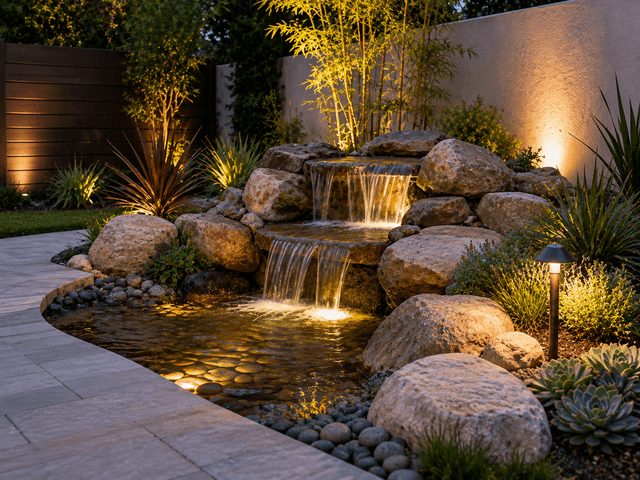
A pondless waterfall gives you stronger sound and a more naturalistic look without the open pond at the bottom. Water disappears into a gravel-covered reservoir and recirculates. That can eliminate some pond-related work, but the system is usually larger and more mechanically demanding than a bubbling urn. More water movement means pump sizing, head height, splash, rock cleaning, and reservoir access matter more. Choose it because you genuinely want the waterfall experience, not because the word pondless sounds maintenance-free.
Open Ponds Are Wrong for a No-Headache Goal
Ponds can be beautiful. They can also be worthwhile when habitat, fish, aquatic planting, or a naturalistic garden is the actual goal. But if the brief is simply "I want to hear water and not maintain much," an open pond is usually more system than you need. Open water receives leaves, dust, pollen, insects, sunlight, and nutrient inputs. If fish or aquatic plants are added, filtration and biological balance become part of the ownership experience. A pond can be a hobby; that is not a criticism. It is a reason to be honest about the brief. For a low-fuss project, use the smallest exposed-water area that still delivers the visual or acoustic effect you want.
Design Algae Out Before You Try to Treat It
Water feature algae is one of the first things homeowners mention when they describe a fountain as "high maintenance." The instinct is often to shop for a stronger treatment. The better first step is to look at design conditions.
- Sun exposure: Full sun can make visible biological growth and evaporation more demanding. Shade can reduce both pressure points, although it does not eliminate maintenance.
- Water movement: Consistent recirculation is preferable to stagnant water, but dead zones can still exist in a poorly shaped basin.
- Organic debris: Leaves, pollen, soil, and other debris add material that eventually has to be removed.
- Reservoir accessibility: If the basin or intake cannot be cleaned, debris simply accumulates where you cannot reach it.
- Surface choice: Some finishes show scale, biofilm, and staining more dramatically than others.
EPA WaterSense notes that recirculating water can help prevent algae growth in ornamental features. That is helpful, but it is not a promise that a recirculating fountain never needs cleaning.
Moving Water Helps With Mosquitoes but Maintenance Matters
Homeowners sometimes assume any fountain automatically solves mosquito concerns because the water moves. The safer assumption is that mosquitoes are a standing-water problem, and any part of the system that becomes stagnant when the pump is off or clogged deserves attention. CDC guidance specifically includes fountains among water-holding places mosquitoes can use.
- Keep the pump operating as designed rather than allowing a neglected basin to sit stagnant.
- Remove leaves and organic debris before they block circulation.
- Inspect hidden reservoirs and low pockets where water can remain still.
- If standing water cannot be drained or maintained, use only mosquito-control products that are labeled for that application and follow the label.
MAINTENANCE REALITY
A fountain that is easy to inspect gets maintained. A fountain that requires moving a 200-pound capstone to reach the pump gets ignored until it fails. Service access is one of the most important design details and one of the least photogenic.
The SoCal Water Question Makes Recirculating Matter
Southern California water planning is another reason to favor a right-sized recirculating fountain over a high-spray decorative feature. EPA WaterSense recommends recirculating ornamental water features and reducing flow where possible to limit potable-water demand and evaporation. California water-efficiency rules and local supplier restrictions can also affect decorative water features, and local requirements can be stricter or change during drought conditions.
The practical design response is simple: specify a closed recirculating system, minimize unnecessary spray, provide an easy way to monitor water level, and verify current local water-use rules before construction. It also pairs well with drought-tolerant, low-water planting so the whole composition stays water-wise. Do not design around an old drought rule you remember from a few years ago. Check the current city or water supplier requirements for the property when the project is actually moving forward.
How Much Water Movement Do You Really Need?
More water does not automatically mean a better water feature. If the goal is sound masking, what matters is the relationship between drop height, surface texture, basin shape, background noise, and how close the listener sits. A modest flow falling onto stone near a patio can sound more effective than a dramatic jet placed at the far end of the yard. High sprays and broad splashing surfaces can increase water loss and wet the surrounding hardscape. EPA WaterSense specifically recommends downward-falling rather than upward-shooting water where evaporation reduction is a goal. Design the sound where people sit, not for the biggest visual effect in a brochure.
Placement Can Make an Easy Fountain Hard to Own
The same fountain can be low maintenance in one location and annoying in another.
- Under a messy tree: Expect more leaves, flowers, fruit, pollen, and cleanup.
- In full afternoon sun: Expect more evaporation and potentially more visible algae pressure.
- Beside a walkway: Control splash so the path does not stay wet or slippery.
- Against a wall: Check how overspray and mineral deposits will affect the finish.
- Far from power and service access: The landscape may look cleaner on day one but be harder to maintain later.
- At the low point of the yard: Do not let stormwater and landscape runoff wash soil and debris into the feature.
If the site already has drainage trouble, solve that first. Understanding why surface water needs a planned route explains why grading has to be handled before you add a basin, reservoir, or hardscape focal point.
Design Around Pump Access From the Start
Most homeowners never see the pump in the finished photos, but the pump determines whether the fountain works next month. A good low-maintenance specification answers these questions before construction:
- Can the pump be reached without removing fixed masonry or heavy decorative pieces?
- Can the intake or prefilter be cleaned easily?
- Can the reservoir be inspected for sediment and debris?
- Is the pump appropriately sized for the intended lift and flow rather than oversized for drama?
- Can the system be shut down and serviced safely?
- Are electrical work, connections, and controls installed in accordance with the manufacturer's instructions and applicable code?
A pump access hatch is not ugly if it is designed into the landscape. It is ugly when a service technician has to pry apart finished stone because nobody planned one.
Hard Water and Scale Show on Some Surfaces
Even a perfectly functioning fountain can look dirty when mineral residue dries repeatedly on the visible surface. How noticeable that becomes depends on the source water, finish color, texture, splash pattern, and how often the surface dries. Dark polished stone and smooth metal can show deposits quickly; textured or naturally variegated materials may disguise them better. If your source water is mineral-rich, plan for cleaning access and choose a finish you are willing to maintain. Do not assume a chemical treatment, sealer, or material can permanently eliminate deposition without checking the product manufacturer's recommendations.
Light the Water Feature Without a Maintenance Trap
A small amount of outdoor lighting can make a water feature dramatically more useful after dark, but fixtures should not make the reservoir harder to access or create glare off the water surface. Keep the lighting scheme simple: light the moving water or the sculptural object, not every square inch around it. Conceal fixtures where they can still be inspected and cleaned, and keep cable routing coordinated with the fountain service path. For a broader night-lighting strategy, see our landscape lighting design guide. The fountain should be one layer in the nighttime composition, not an isolated spotlight effect.
Seven Specifications for a Low-Maintenance Water Feature
If your priority is "water without the headache," use this as the design brief:
- Recirculating system with no once-through decorative water use.
- Small exposed-water area relative to the visual and acoustic effect you want.
- Moderate, controlled flow with limited overspray and unnecessary high jets.
- Easy pump, intake, and reservoir access without dismantling finished hardscape.
- Placement that avoids major leaf drop, uncontrolled runoff, and excessive full-sun exposure where practical.
- A clear splash and drainage plan around adjacent paving, walls, and planting.
- A maintenance routine the homeowner will actually do: top-off, debris check, wipe-down, pump inspection, and periodic deeper cleaning.
This specification is deliberately boring. That is why it works.
Common Low-Maintenance Water Feature Mistakes to Avoid
- Do not install a large pond because you only wanted the sound of water. Match the system to the job.
- Do not bury the pump where it cannot be removed without destroying the finished landscape.
- Do not assume recirculating means maintenance-free. It reduces water demand; it does not remove debris or scale for you.
- Do not use a high spray where wind can carry water onto walls, furniture, or walkways.
- Do not place the feature under the messiest tree in the yard unless you are comfortable cleaning it frequently.
- Do not route storm runoff into the reservoir. Soil and mulch quickly become pump problems.
- Do not ignore standing water if circulation stops. Fountains can become mosquito habitat when water sits unmanaged.
- Do not choose a finish solely from a dry showroom sample. Ask how it looks wet, how it looks with mineral residue, and how it will be cleaned.
- Do not build first and figure out electrical access, drainage, top-off, and maintenance later. Those are design decisions.
Use a Simple Water-Feature Decision Framework
Choose the smallest system that satisfies the experience you actually want.
| If You Want… | Start by Comparing… | Be Cautious About… |
|---|---|---|
| Soft sound near a patio | Bubbling urn, sphere, compact disappearing fountain | Oversized waterfall systems |
| A courtyard focal point | Wall fountain or sculptural recirculating fountain | Splash against finishes and full-sun basin placement |
| Natural waterfall sound | Pondless waterfall | Calling it "low maintenance" without planning access |
| Fish, aquatic plants, habitat | Purpose-designed pond | Treating it like a decorative fountain |
| The least visible maintenance | Small recirculating feature with concealed reservoir | Hidden service access that is actually inaccessible |
Build the Feature You Will Still Like Maintaining
A water feature should make the yard calmer, not give you another system to worry about every weekend. For most Southern California homeowners, the low-maintenance water feature answer is not a giant pond with more equipment. It is a right-sized recirculating feature with restrained flow, a small exposed-water area, thoughtful shade and drainage, and service access that is obvious before anything gets covered by stone. The best feature is the one whose maintenance matches your tolerance. If you enjoy pond care, build a pond deliberately. If you want sound and movement with minimal fuss, keep the water volume, splash, biology, and mechanical complexity under control.
Choose the Feature You Will Still Maintain
Compare feature type, exposed water, pump access, algae risk, splash, top-off needs, debris exposure, and cleaning access before you commit to a design. For a property-specific plan, visit our hardscaping services or book a consultation and call +1 (818) 303-1570.
Frequently Asked Low-Maintenance Water Feature Questions
What Is the Lowest-Maintenance Water Feature for a Backyard?
For many homeowners, a small recirculating feature with a concealed reservoir — such as a bubbling urn, sphere, or disappearing fountain — is one of the easiest formats to live with. It limits exposed water while keeping the visual and acoustic effect. It still needs routine water-level checks, debris removal, pump access, and periodic cleaning.
What Exactly Is a Disappearing Fountain?
A disappearing fountain sends visible water over an urn, stone, bowl, or other feature and then drains it through a grate or decorative stone into a hidden reservoir. A pump in the reservoir recirculates the same water back to the top. The design reduces the amount of open water you see, but the reservoir and pump still need accessible service points.
Are Recirculating Fountains More Water-Efficient Than Ponds?
Recirculating fountains reuse the water already in the feature rather than continuously sending new water through it. EPA WaterSense recommends recirculation for ornamental water features and notes that lower flows, smaller pumps, shaded placement, and downward-falling water can further reduce water loss. Evaporation and splash still require periodic top-off.
How Do I Prevent Algae in a Backyard Fountain?
Start with design and maintenance rather than expecting a single treatment to solve everything. Maintain reliable circulation, remove organic debris, keep the reservoir accessible for cleaning, avoid unnecessary full-sun exposure where practical, and follow the fountain or treatment manufacturer's instructions. EPA WaterSense notes that recirculating water can help prevent algae growth, but no fountain is algae-proof.
Do Backyard Fountains Attract Mosquitoes in SoCal?
Fountains can become mosquito habitat if water remains stagnant or poorly maintained. CDC guidance identifies fountains as water-holding places mosquitoes can use. Keep the system circulating as designed, clear debris that blocks flow, inspect hidden standing-water areas, and address water that remains stagnant when the pump is off.
Is a Pondless Waterfall Low Maintenance?
A pondless waterfall can be easier than an open pond because it does not have a visible pond ecosystem, but it is usually more complex than a small bubbling fountain. Pump sizing, reservoir access, rock cleaning, leaves, splash, and water loss still need attention. Choose it for the waterfall experience, not because the word pondless sounds maintenance-free.
Where Should I Place a Low-Maintenance Water Feature in SoCal?
A good location balances sound, shade, debris, drainage, power, and service access. Avoid the heaviest leaf drop, uncontrolled storm runoff, and a splash path across walking surfaces. Placing the feature close enough to the sitting area to hear it can also let you use a gentler flow rather than a larger, higher-spray fountain.
How Often Does a Backyard Fountain Need Maintenance?
There is no single schedule for every fountain because maintenance depends on water volume, exposure, pump design, debris, weather, source-water minerals, and how often the feature runs. Plan on frequent visual checks for water level and debris, plus periodic cleaning and pump inspection according to the equipment manufacturer's instructions.
Do I Need to Check Local Water Rules Before Adding a Fountain?
Yes. California and local water-efficiency rules can change, and local cities or water suppliers may impose additional restrictions during drought or shortage conditions. A closed recirculating design is the sensible baseline, but current requirements should be confirmed for the property before construction or operation.
Thinking about a new outdoor space?
We’d love to hear your ideas. Let’s explore what’s possible—no pressure, just a friendly conversation.
Give us a call:
+1 (818) 303-1570
Frequently Asked Question
WHAT DOES A LANDSCAPE DESIGN COST?
You purchase a landscape designer’s expert consultation time, and, typically, your project’s design plan. Landscape designers bill for their services in various ways. Design is ordinarily billed on an hourly basis or as a flat fee. It is important that the homeowner and the landscape designer have an early discussion and agreement about the cost of services.