
OUR MISSION IS TO TAILOR FOR EACH CLIENT A BEAUTIFUL, FUNCTIONAL AND ENDURING OUTDOOR ENVIRONMENT THAT WILL PROVIDE A PLACE OF SERENITY FOR FRIENDS AND FAMILY TO APPRECIATE FOR YEARS TO COME.

BuildCal Landscape Hardscaping Article
Why Your Yard Floods When Your Neighbor's Doesn't (Clay Soil, Grading & Runoff)
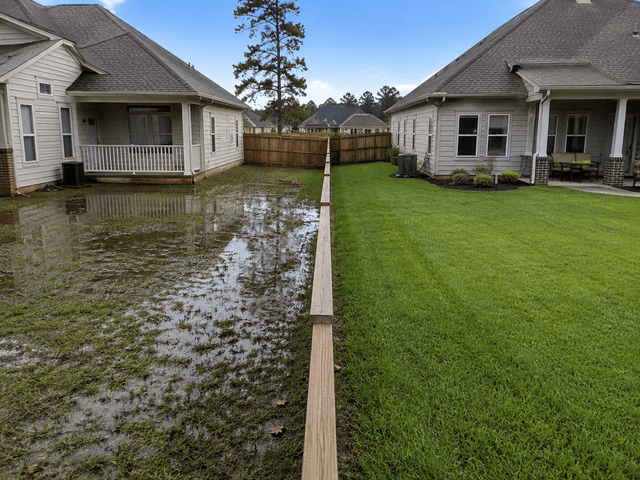
Same rainstorm. Same street. Same weather app on both phones. Yet your yard is a swamp and your neighbor's looks fine. If you've stood at the window watching this happen and thought "what am I doing wrong?" — you're not alone. "My yard floods but neighbor's doesn't" is one of the most common frustrations homeowners bring to a drainage pro, and it almost always has a real, findable cause.
The good news: the fact that only your yard is flooding is actually useful information. It rules out "it's just a lot of rain" and points straight at something about your lot — soil, grade, or where runoff is coming from. This piece is a diagnostic: how to figure out which of the three (usually a mix) is at work, and what the right response is. For the bigger picture on hardscape and drainage, see our hardscaping services, and read on.
The Three Usual Suspects
When one yard floods and the next doesn't, one or more of three factors is almost always responsible: the soil, the grade, or runoff arriving from somewhere else. Drainage and neighbor-dispute forums repeat this pattern constantly — flat lots, heavy clay, and higher-lying neighboring properties come up over and over.
Here's how each one shows up, and how to tell them apart.
Clay Soil: Water Sits Because It Can't Get In
Clay soil drainage is one of Southern California's quiet culprits. Clay particles pack tightly, leaving very little space for water to move through, so rain that hits a clay yard sits on top or seeps in extremely slowly. Your neighbor's yard, on the very same street, may sit on sandier soil or better structure and drain just fine.
How to tell clay is your issue:
-
Water pools broadly across the yard, not just in low spots.
- The lawn stays saturated or squelchy days after the rain has stopped.
- Wet, sticky, gray-brown soil that forms a ribbon when you roll it between your fingers.
- Cracks appear across the surface in summer as the soil dries out.
Related: compacted soil drainage looks almost identical from above. Foot traffic, construction, heavy equipment, and even repeated mowing can compact a yard until water no longer penetrates. Compacted soil often responds to aeration, decompaction, and organic-matter amendment; heavy native clay usually needs a bigger drainage strategy - not a French drain alone. See our broader yard drainage solutions for the treatment side.
Poor Yard Grading: Water Has Nowhere to Go
The second suspect is grade — the shape of the land. Even a yard with decent soil floods if the ground is flat or slopes the wrong way. This is quietly the most common cause of standing water lawn issues on otherwise identical lots.
How to tell grading is your issue:
-
Water pools in the same low spots after every rain, and sits until it evaporates.
- Puddles form near the house — often a sign the yard slopes back toward the foundation.
- Rain runs across the surface but has no clear route out of the yard.
- Your neighbor's yard is visibly higher in the middle, sloping gently outward — yours isn't.
Poor yard grading is often invisible until it rains. It also isn't rare — a lot of tract-built yards were finished flat or with subtle slope errors that only reveal themselves years later. Fixing it means reshaping the ground so water runs the right way, sometimes combined with a swale or French drain depending on where the water needs to go. See our related look at proper base and grading and hardscape design.
Runoff From Somewhere Else
The third suspect explains a lot of "why me?" flooding: your yard is downhill of something. In a neighborhood where lots aren't perfectly level, runoff can travel yard to yard, driveway to driveway, and roof to yard in surprising volumes.
Common sources of uphill neighbor runoff:
-
A neighboring yard graded so its surface flow drops into yours.
- A hillside or higher property releasing sheet flow toward your lot.
- A neighbor's downspouts or gutters discharging near your property line.
- A driveway or hardscape uphill that funnels water directly at your yard.
- Intentional discharge, such as pool draining or hose runoff sent over the fence line.
How to tell runoff is your issue:
-
Water enters your yard along one edge — the uphill side — before it puddles anywhere else.
- You can see or hear water flowing in from a neighboring property during rain.
- Wet zones concentrate in a line or path, not spread across the yard.
- Your own downspouts and grade look fine, but the yard still floods.
Runoff issues are technical, but they can also get social. It's usually best to start with your own drainage first — many uphill-runoff problems are fully solvable on your side of the fence with a swale, regrading, or intercepting drain — before raising the situation with a neighbor. Where a neighbor's discharge is intentional or clearly negligent, local rules may apply, but a conversation and, if needed, a mediator go further than a confrontation. Our note on retaining wall drainage covers how walls between properties factor in.
How to Tell Which One Is Yours
Most flooded yards involve two of the three, sometimes all three. A quick self-triage after the next rain can point you in the right direction.
- Water enters along one edge, then spreads → Runoff from uphill or a neighbor.
- Puddles form at the same low spots and sit → Grade.
- Whole yard stays saturated for days → Soil (clay or compaction).
- Water pools right under downspouts → Downspout drainage - usually the first fix regardless.
- Puddles right against the house → Grade sloping back toward the foundation - address quickly.
Grab our free Yard Flooding Triage Checklist — a one-pager that walks you through the after-rain observations that separate soil, grade, and runoff, so you go into a contractor conversation knowing what you're actually dealing with.
The Right Fix Depends on the Right Cause
Each of the three suspects has its own set of fixes. Matching the fix to the cause is what stops the money-wasting cycle of "try one thing, still flooded, try another."
- Clay or compacted soil: Aeration, decompaction, organic-matter amendment, planted infiltration - and often surface routing (grade or swale) because the soil can't be relied on to move water down fast.
- Poor grading: Regrade the yard so water runs to a safe outlet - sometimes paired with a swale.
- Uphill runoff: Intercepting drains or swales at the uphill edge, regrading to route flow around key areas, and dedicated patio drainage for hardscape surfaces.
- Any downspout issue: Extend or bury downspouts to a safe outlet away from the house - almost always the first step.
Because most flooded yards have layered causes, the best plans combine several small, cheaper interventions rather than one expensive over-engineered one. That's exactly why an on-site diagnosis pays off: comparing quotes on diagnosis and workmanship, not just price, saves the most money in this category.
What Not to Do
A few well-meaning moves make things worse, so they're worth naming:
-
Adding fill soil to a wet spot without a plan for where the water goes - it usually just pushes the puddle sideways.
- Installing a French drain without confirming subsurface water is actually the issue - see the caveat about clay above.
- Diverting runoff onto a neighbor's property or into a street storm drain the city hasn't approved for it - both can create liability.
- Ignoring downspouts and roof water - no downstream fix keeps up while gutters dump at the base of the house.
- Waiting. Persistent standing water damages lawn, kills plants, breeds mosquitoes, and, near the house, threatens the foundation.
Get a Straight Answer About Your Yard
You don't have to keep guessing why yours is the yard that floods. Book a free drainage assessment and we'll walk your yard, trace the water, check soil, grade, downspouts, and any uphill influences, and tell you honestly what's causing the flooding and the most durable fix - or combination of fixes - to solve it. Call +1 (818) 303-1570 or contact us to schedule, and explore our hardscape and drainage work.
Frequently Asked Questions
Why does my yard flood but my neighbor's doesn't?
Same street, different result usually comes down to one or a combination of three things: your yard has heavier or more compacted soil (clay soil drainage or compacted soil drainage), it isn't graded to move water off, or it's receiving runoff from an uphill neighbor, driveway, or property. Most flooded yards have layered causes, and after-rain observations - where water enters, where it pools, how long it stays - point to the culprit.
How can I tell if I have clay soil drainage problems?
Signs of clay soil issues include water pooling broadly (not just in low spots), a lawn that stays saturated days after rain, sticky wet soil that forms a ribbon when rolled between your fingers, and cracks across the surface as the soil dries out in summer. Compacted soil looks similar and often responds to aeration and organic-matter amendment. Heavy native clay usually needs a bigger drainage plan than a drain alone.
What do I do about uphill neighbor runoff into my yard?
Start on your side of the fence. Many uphill-runoff problems are fully solvable with a swale, an intercepting drain, or regrading along the uphill edge to route water around key areas. Where a neighbor's discharge is intentional or clearly negligent, local rules may apply, but a conversation - and a mediator if needed - goes further than a confrontation. Diverting runoff back onto a neighbor or into an unapproved outlet can create liability, so it's not a DIY answer.
Is poor yard grading really that common?
Yes. Poor yard grading is one of the most common causes of standing water lawn problems, especially on tract-built lots that were finished flat or with subtle slope errors. It's often invisible until it rains, when puddles form in the same low spots or, more concerning, right against the house. Regrading to shape the ground so water runs to a safe outlet is a durable, low-maintenance fix.
How do I get my flooded yard diagnosed?
Walk your yard the day after a rain and note where water enters, where it pools, how long it stays, and where any downspouts discharge. Then get an on-site assessment from a professional who checks soil, grade, downspouts, and any uphill influences before proposing anything. Book a free drainage assessment at +1 (818) 303-1570 to get a clear read on which of the three causes - or which combination - is behind your flooding.
Thinking about a new outdoor space?
We’d love to hear your ideas. Let’s explore what’s possible—no pressure, just a friendly conversation.
Give us a call:
+1 (818) 303-1570
Frequently Asked Question
IS THERE A FEE FOR THE INITIAL CONSULTATION?
No, we do not charge for the initial site visit. This is your opportunity to share your ideas and vision for your landscape project, start the process of design by discussing initial ideas, pin-point any landscape problems you are having, and get a scope of the overall size of scope. Plus this gives you the opportunity to meet us, learn more about our company, and ask questions.