
OUR MISSION IS TO TAILOR FOR EACH CLIENT A BEAUTIFUL, FUNCTIONAL AND ENDURING OUTDOOR ENVIRONMENT THAT WILL PROVIDE A PLACE OF SERENITY FOR FRIENDS AND FAMILY TO APPRECIATE FOR YEARS TO COME.

BuildCal Landscape Landscape Maintenance Article
You Paid for a Beautiful Yard — Here's How to Keep It From Falling Apart in Year One
QUICK ANSWER
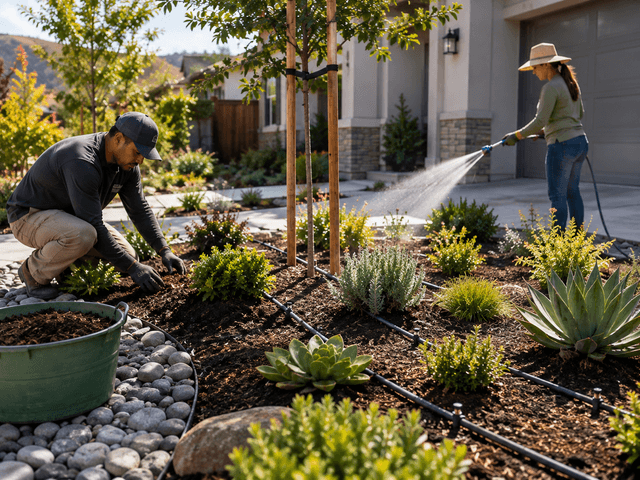
Protect a new landscape by checking it more often in the first year, not by doing more of everything. Keep new root balls adequately moist but not constantly saturated; adjust irrigation as weather and rooting change; maintain mulch without piling it against trunks or crowns; avoid heavy early pruning and unnecessary fertilizing; limit traffic on new turf; inspect paver joints, drainage, and stains before small issues spread; and document plant problems early if your written warranty has care requirements.
You just paid for a beautiful yard, and the fastest way to lose that investment is to treat a brand-new landscape like an established one. New plantings, fresh sod, and newly set pavers all behave differently in their first twelve months, and the routine that keeps a mature yard healthy can quietly kill a new one. If you need new landscaping aftercare in SoCal, the first year is about helping roots establish, adjusting irrigation as the landscape changes, protecting mulch and hardscape, and catching small problems before they turn into expensive failures. The good news is that year one rewards attention more than effort: frequent short check-ins beat doing more of everything. This guide walks through the first 30 days, watering transitions, pruning, fertilizer, sod, warranty documentation, and the point where aftercare should hand off to a regular maintenance plan.
New Landscaping Aftercare in SoCal Makes Year One Different
A mature landscape can tolerate routines that a newly installed landscape cannot. Established roots occupy a much larger soil volume. New roots do not. That difference changes watering, monitoring, and even how quickly a plant can recover from heat or a missed irrigation cycle. UC guidance for newly planted trees and shrubs consistently emphasizes keeping the root ball and immediately surrounding soil adequately moist during establishment, then increasing the interval between waterings as roots expand. The trap is leaving the controller on the original establishment schedule forever.
THE KEY TRANSITION
Early establishment means closer moisture monitoring and sometimes more frequent irrigation. Successful establishment means gradually less frequent, more thorough watering over a larger root zone. The exact timing depends on plant type, soil, exposure, season, emitter output, and weather.
Your First 30 Days Are for Observation
The first month is when the landscape needs the most observation because installation variables are still revealing themselves. Do a short walk-through several times a week and look for:
- A root ball that is dry while the soil around it is wet.
- A root ball that stays waterlogged for days.
- Emitters that are clogged, disconnected, or missing the intended root zone.
- Spray heads hitting walls, trunks, fences, windows, or hardscape.
- Mulch pushed tightly against stems or tree trunks.
- Plants tilting because the root ball settled or irrigation washed soil from one side.
- Low spots holding water after irrigation.
- Wilt, leaf scorch, sudden yellowing, or branch dieback that is getting worse rather than stabilizing.
- Fresh sod lifting at an edge or drying at seams.
- Paver joint sand visibly disappearing from runoff, cleaning, or concentrated downspout flow.
The goal is not to diagnose every symptom instantly. It is to catch a pattern before it becomes a dead plant or a bigger repair.
Water the Roots You Have Then Follow New Growth
The most important part of first year plant care is understanding where the roots actually are. A new shrub in a five-gallon container does not immediately use the same soil volume as a three-year-old shrub in the ground. Early watering has to wet the root ball itself and some of the surrounding soil so roots can grow outward. UC Cooperative Extension guidance notes that newly planted shrubs may require very frequent irrigation early in establishment and then less frequent irrigation as they become rooted. Newly planted trees likewise need regular watering through the first season, including drought-tolerant species. That does not mean every new plant should run on one daily schedule. Soil texture matters. Hot exposure matters. Container size matters. Drip rate matters. Clay can remain wet much longer than sandy soil.
THE SOIL CHECK BEATS THE TIMER
Before adding another watering day, check moisture a few inches into the root zone. If the root ball is still wet, adding water can create a different problem. If the root ball is dry while nearby soil is moist, emitter placement or run time may be wrong.
How to Taper Irrigation Without Stressing the Landscape
- Keep the original establishment zone moist enough for the plant to avoid repeated drying during the early rooting period.
- Check the soil and root ball before changing the schedule.
- As rooting expands, move or add drip coverage outward where appropriate instead of watering only beside the trunk forever.
- Increase the time between irrigation events gradually rather than abruptly shutting the system down.
- When you irrigate less often, make sure each event actually rewets the intended root zone instead of only dampening the surface.
- Recheck the schedule after major weather changes: heat waves, Santa Ana winds, cooler fall weather, and meaningful winter rain all change demand.
This taper is how you move from nursery root-ball care to landscape soil care.
Overwatering Can Look Just Like Underwatering
Yellowing, wilt, weak growth, and leaf drop can tempt a homeowner to add water. Sometimes that is exactly the wrong response. UC IPM notes that excess moisture and poor drainage can contribute to root and crown disease. New plants should not sit in constantly saturated soil, and water should not pond around trunks or crowns. Before increasing irrigation, ask:
- Is the root ball actually dry below the surface?
- Does the hole or bed drain after irrigation?
- Is mulch hiding wet soil?
- Is a drip line leaking under the mulch?
- Is a sprinkler from another zone also watering the same plant?
- Is the symptom concentrated in one hydrozone or one low spot?
One wet plant among otherwise healthy plants often points to a local condition, not a reason to increase the entire controller.
Mulch Is Part of the Irrigation System
Mulch reduces soil moisture loss, suppresses weeds, and moderates soil temperature. In Southern California, that makes it one of the simplest ways to stabilize a new planting bed. But mulch has to be placed correctly. UC sources commonly recommend roughly a 2–4 inch mulch layer around trees and shrubs while keeping mulch several inches away from trunks, stems, and crowns. The shape you want is a broad, flat layer, not a volcano piled against the plant.
- Keep the trunk flare and crown visible.
- Re-level mulch after wind, pets, irrigation, or maintenance crews move it.
- Do not keep adding fresh mulch every visit without checking how deep the old layer already is.
- Make sure drip water is reaching soil under the mulch rather than running along the surface.
- Remove weeds early so they do not compete with new roots for water.
MULCH WARNING
More is not automatically better. Deep mulch piled against woody stems can hold moisture at the crown and contribute to disease problems. In fire-prone locations near structures, the material and location of mulch also need to follow current defensible-space guidance.
Do Not Rush to Prune a New Landscape Into Shape
A new yard often looks slightly looser than the rendering because plants have not filled in yet. That is not a reason to shear everything immediately. UC guidance for newly planted trees cautions against heavy pruning at planting; damaged, broken, crossing, or structurally problematic growth can be addressed, but excessive pruning can slow establishment. Shrubs also need enough foliage to photosynthesize and support root growth. In the first year, pruning should usually have a reason:
- Remove dead, broken, damaged, or clearly diseased growth.
- Correct a branch that is rubbing or creating a real structural problem.
- Protect a walkway, address number, window, or required clearance.
- Train young plants toward the intended framework where species-appropriate.
- Avoid repeated shearing simply to force a mature formal shape before the plant is established.
If the design only works when every shrub is cut back hard every month, the plant choice or spacing may be the real problem.
Be Conservative With Fertilizer in the First Year
New plants do not always need a feeding schedule simply because they are new. UC IPM recommends fertilizing young woody plants sparingly in the first growing season, and Southern California UC guidance notes that many nursery-grown trees already have adequate nutrition at planting. Too much fertilizer can push soft growth, increase water demand, or damage young roots. Use visible deficiency, soil information, plant requirements, and the maintenance plan, not a blanket "new yard equals fertilizer" rule.
New Sod Has Its Own Establishment Rules
If the project includes new sod, do not apply established-lawn habits on day one. UC IPM's Healthy Lawns program recommends keeping new sod moist while roots establish, avoiding saturation below the turf, limiting traffic during early establishment, and waiting until roots are firmly anchored before the first mowing. The first weeks are about root contact.
- Check seams and edges first; they can dry faster.
- Avoid heavy furniture, repeated foot traffic, and pets using the same route across unrooted turf.
- Do not mow simply because the blades look tall; confirm the sod is rooted enough that mowing will not pull it up.
- Once the turf is established, transition away from very frequent shallow irrigation toward the deeper schedule appropriate for the species and site.
If the lawn develops a persistent problem after establishment, a problem-specific diagnosis is more useful than continuing an establishment schedule indefinitely.
Irrigation Needs 30-Day 90-Day and Seasonal Resets
A controller programmed on installation day is not a finished irrigation plan. Plants grow. Weather changes. Drip emitters become buried by mulch. Lawn roots deepen. Rain arrives. Treat the first year as a series of resets.
| Checkpoint | What to Inspect | Typical Adjustment | Why It Matters |
|---|---|---|---|
| First 2–4 weeks | Root-ball moisture, emitter placement, leaks, runoff | Correct coverage and obvious over- or underwatering | Prevents early establishment failure |
| Around 1–3 months | New root spread, plant response, sod rooting, mulch movement | Begin widening intervals where plants are establishing | Stops an emergency schedule from becoming permanent |
| Start of hot season | Sun exposure, wind, controller runtime, clogged emitters | Recalibrate for heat without defaulting to daily saturation | Peak demand exposes weak zones |
| Start of cool/rain season | Rainfall, soil moisture, drainage, overspray | Reduce or pause irrigation when soil stays moist | Avoids winter overwatering |
| Plant growth milestones | Emitter location relative to expanding canopy and root zone | Move or add distribution outward as needed | Follows roots beyond the original nursery ball |
If you see runoff, misting, leaking valves, broken heads, or a zone that never seems to match the rest of the yard, separate a scheduling issue from an equipment issue before making changes.
The First Year of Hardscape Care Is Mostly Observation
New landscape maintenance does not stop at the plant edge. Patios, walkways, retaining edges, decomposed-granite areas, drains, and pavers are all settling into real use during the same first year. For interlocking concrete pavers, the Concrete Masonry & Hardscapes Association identifies joint-sand condition as an important maintenance item, and it helps to understand how paver materials and joint sand behave over time. Focused pressure washing can remove joint sand, while joint loss, settlement, loose edge restraints, or faulting can point to maintenance — or sometimes an underlying construction issue, which is why it helps to recognize early warning signs of settlement and structural movement. You do not need to obsess over every color variation or small amount of efflorescence. You do need to notice movement, drainage, and joint condition.
- Sweep rather than using aggressive pressure as the default cleaning method.
- Clean food, oil, rust, leaf, or irrigation stains early using products appropriate to the surface.
- Watch downspouts and irrigation runoff that repeatedly cross paver joints.
- Check whether joint sand is disappearing in concentrated areas.
- Note pavers that rock, settle, or create a new trip edge.
- Keep drains and channel grates clear of mulch, soil, and leaves.
- Do not seal a surface simply because the project is new; follow the paving-product and installer guidance for timing and compatibility.
Protect New Landscaping From Everyday Damage
A surprising amount of year-one decline is mechanical, not horticultural. The landscape is new, but family habits are old. Choosing resilient, low-maintenance plants helps, but so does protecting them from routine wear.
- Keep delivery carts and heavy equipment off fresh planting beds and unrooted sod.
- Move pet routes away from young shrubs that are repeatedly being stepped on or urinated on.
- Keep string trimmers and mower decks away from young tree trunks.
- Do not tie hammocks, lights, decorations, or hoses tightly around new trunks.
- Keep pool splash, salt, or chemical discharge from repeatedly reaching sensitive planting.
- Do not stack bags of soil, mulch, construction materials, or firewood over new root zones.
- Use furniture feet and pads appropriate to new paver or finish surfaces where concentrated loads could stain or scratch.
Read the Landscape Warranty Terms Before a Problem
"Landscape warranty care" is not one universal set of rules. Coverage varies by contract, plant, material, installer, maintenance responsibility, irrigation conditions, weather events, owner changes, and how quickly a problem is reported. So do not rely on an article to tell you what is or is not covered. Instead, protect yourself with documentation:
- Keep the final contract, plant list, irrigation schedule, product information, and written warranty together.
- Take dated photos of the finished landscape and again if a plant or surface begins to decline.
- Keep notes on controller changes, unusual weather, irrigation failures, or repairs.
- Follow any written care instructions that are explicitly tied to warranty coverage.
- Report a developing issue promptly rather than trying several aggressive fixes first.
- Do not assume a dead plant proves bad installation, or that it automatically proves owner neglect. Diagnose the water, drainage, planting, exposure, pest, and maintenance conditions.
WARRANTY REALITY
The safest language is simple: follow the written warranty and aftercare instructions for your specific project. Do not invent a universal "voids the warranty" list. If a care requirement matters to coverage, it should be documented in the project terms.
What a First-Year Maintenance Visit Should Actually Check
A maintenance visit is most valuable when it is diagnostic, not just cosmetic. For a new landscape, the visit should answer whether the system is establishing as designed.
| Area | What to Check | Why It Matters |
|---|---|---|
| Plants | Moisture, vigor, dieback, pests, staking, mature-space conflicts | Catches establishment stress before replacement is the only option |
| Irrigation systems | Leaks, pressure, clogged emitters, overspray, controller schedule, root-zone coverage | Water delivery is the main establishment variable |
| Mulch / soil | Depth, crown clearance, weeds, erosion, compaction | Controls moisture and root-zone conditions |
| Trees | Ties, stakes, trunk injury, lower structural branches, watering radius | Prevents girdling and keeps care aligned with root expansion |
| Turf | Rooting, mowing height, dry seams, traffic damage, uniform coverage | Helps move from establishment to normal lawn care |
| Hardscape | Joint sand, stains, drainage, settlement, edge movement | Small defects are easier to document early |
| Drainage | Ponding, clogged drains, erosion, runoff paths | Protects both plants and permanent surfaces |
Where you see ponding, clogged drains, or runoff repeatedly crossing the same surfaces, it helps to understand why grading and runoff cause standing water so the fix addresses the cause, not just the symptom.
Seasonal Maintenance Matters but Year One Differs
This article is intentionally not a generic seasonal checklist. A seasonal checklist asks what every landscape should do in spring, summer, fall, and winter. First-year aftercare asks a different question: what is still establishing, what can be tapered, and what has to be corrected before it becomes the new normal? Once the landscape has moved through establishment, the broader spring, summer, fall, and winter cycle becomes the main focus.
Use the First-Year Aftercare Decision Calendar
Use this as a decision calendar rather than a rigid watering calendar.
| Period | Main Goal | Priority Checks |
|---|---|---|
| Weeks 1–4 | Stabilize installation | Root-ball moisture, emitter function, runoff, mulch, sod rooting, plant lean, drainage |
| Months 2–3 | Confirm establishment trend | Begin irrigation taper where appropriate, check new growth, adjust emitters, reduce unnecessary staking and ties |
| Months 4–6 | Follow expanding roots | Widen wetting pattern, watch summer heat, control weeds, inspect paver joints and drains |
| Months 7–9 | Avoid maintenance overreaction | Light corrective pruning only, reassess fertilizer need, check controller against current weather |
| Months 10–12 | Transition to normal maintenance | Confirm stable irrigation schedule, replace unresolved failures, document warranty issues, set recurring care plan |
Common First-Year Aftercare Mistakes to Avoid
- Do not leave the irrigation controller on the original establishment schedule for the entire year without soil checks.
- Do not respond to every yellow leaf by adding water.
- Do not pile new mulch on top of old mulch until trunks and crowns disappear.
- Do not shear newly planted shrubs repeatedly just to make them look mature faster.
- Do not fertilize every new plant automatically.
- Do not let tree stakes or ties remain tight enough to girdle a growing trunk.
- Do not mow or heavily traffic sod before it is firmly rooted.
- Do not pressure wash pavers aggressively enough to blast out joint sand.
- Do not ignore ponding, erosion, or drainage changes because the plants still look green.
- Do not assume a maintenance company automatically knows the installation intent; provide the plant list, irrigation zones, special material instructions, and warranty care requirements.
- Do not wait until a plant is fully dead to document a warranty concern.
Make Time for a Five-Minute Weekly Walk
For the first growing season, one short inspection can prevent a lot of expensive-looking failure.
- Touch the soil in two or three representative root zones.
- Look under mulch for leaks or saturated spots.
- Check the driest-looking plant and the wettest-looking plant, not just the average ones.
- Walk the paver edges, drains, and low points.
- Look at tree ties, sod seams, and pet or traffic damage.
- Make one controller change only if the soil or weather supports it, then observe the result.
The point is to make small corrections before they become emergency replacements.
Protect the Design by Maintaining the System
A successful first year is not the year when nothing changes. It is the year when the landscape changes in the right direction. Roots move outward. Watering frequency becomes less frantic. Trees become self-supporting. Sod transitions to normal mowing and irrigation. Mulch settles into a stable layer. Paver joints stay full. Drainage keeps working. The maintenance plan becomes less about rescue and more about preserving form. That is how good new landscaping aftercare protects the investment: not by freezing installation day in place, but by managing the transition from new to established.
Protect the Investment With a Real Aftercare Plan
Track watering changes, mulch, pruning, sod, irrigation inspections, drainage, hardscape condition, and warranty documentation month by month. For a property-specific maintenance plan, visit our gardening and maintenance services or book a consultation and call +1 (818) 303-1570.
Frequently Asked New Landscaping Aftercare Questions
How Often Should I Water New Landscaping in Southern California?
There is no one schedule for every new landscape. Newly planted trees, shrubs, and perennials generally need more frequent moisture during establishment than they will after rooting, but the correct frequency depends on soil, plant type, container or root-ball size, sun, weather, and emitter output. Check the root ball and nearby soil, then widen intervals gradually as roots establish.
How Long Does Plant Establishment Watering Last?
Establishment is a transition, not a fixed date. Some plants need close moisture management for a full growing season or longer, while the irrigation pattern should change as roots expand. UC guidance for new trees and shrubs emphasizes frequent early monitoring followed by less frequent, deeper watering as plants become well rooted.
Can I Overwater Newly Planted Shrubs?
Yes. Constantly saturated soil can reduce oxygen around roots and contribute to root or crown disease. Check soil moisture before adding water, make sure the planting area drains, and confirm that another sprinkler zone or leak is not also wetting the plant.
How Much Mulch Should New Landscaping Have?
UC sources commonly recommend about 2–4 inches around trees and shrubs, depending on the mulch, while keeping it several inches away from trunks, stems, and crowns. Avoid volcano mulching or repeatedly adding layers without checking the total depth.
Should I Prune New Shrubs and Trees Early?
Prune with a purpose. Remove damaged, dead, crossing, diseased, or structurally problematic growth and make species-appropriate training cuts when needed. Avoid heavy or repetitive pruning simply to force a mature shape before the plant has established.
When Should I Fertilize a New Landscape?
Do not assume every new plant needs immediate fertilizer. UC IPM recommends fertilizing young woody plants sparingly during the first growing season. Use the plant's requirements, visible condition, soil information, and maintenance plan rather than a blanket schedule.
How Do I Care for Newly Installed Sod?
Keep new sod moist while it roots, avoid saturating the soil below it, limit traffic during early establishment, and wait until the roots are firmly anchored before mowing. As rooting develops, move away from frequent shallow irrigation toward the schedule appropriate for the turf species and site.
How Do I Protect New Pavers in the First Year?
Keep the surface clean, avoid unnecessarily aggressive pressure washing, monitor joint sand, keep drainage paths open, and document any settlement or movement. For interlocking concrete pavers, joint sand is part of the pavement system, so repeated sand loss deserves attention.
What Can Void a Landscape Warranty?
There is no universal answer. Warranty terms vary by project and contract. Follow the written aftercare requirements for your installation, keep records of irrigation and maintenance changes, photograph problems early, and report developing issues promptly. Do not rely on a generic online "voids warranty" list.
When Does New Landscaping Aftercare Become Regular Maintenance?
The transition happens when establishment tasks are no longer the dominant issue: plants are rooted, irrigation has been tapered to a stable seasonal schedule, sod is established, tree staking is no longer needed where appropriate, and the site has no unresolved drainage or hardscape defects. At that point, recurring seasonal maintenance becomes the main focus.
Thinking about a new outdoor space?
We’d love to hear your ideas. Let’s explore what’s possible—no pressure, just a friendly conversation.
Give us a call:
+1 (818) 303-1570
Frequently Asked Question
CAN YOU PROVIDE A LANDSCAPE PLAN?
Yes – we have our own Design group who can draw anything from basic hand-drawn layouts and sketches, highly detailed concept plans, or a complete set of working construction drawings. Clients will often call upon us to provide this service as a first step to their overall project.