
OUR MISSION IS TO TAILOR FOR EACH CLIENT A BEAUTIFUL, FUNCTIONAL AND ENDURING OUTDOOR ENVIRONMENT THAT WILL PROVIDE A PLACE OF SERENITY FOR FRIENDS AND FAMILY TO APPRECIATE FOR YEARS TO COME.

BuildCal Landscape Drainage & Grading Article
Standing Water in the Yard After Rain? French Drain vs Regrading
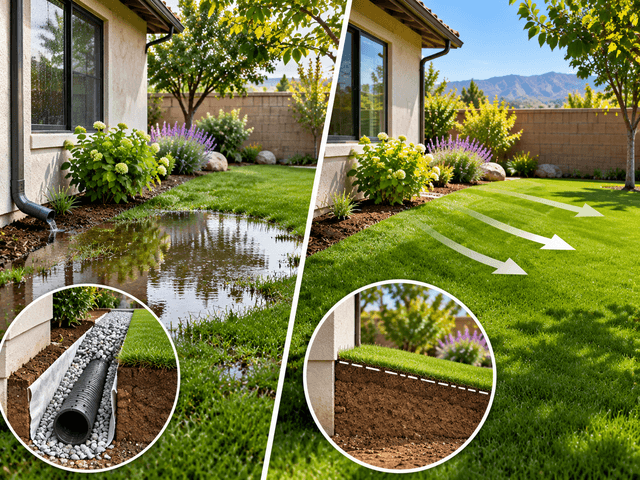
If your backyard turns into a lake after every storm and you're searching how to fix standing water in your yard, the short answer is that it comes down to three main fixes: regrading the yard so water flows away, installing a French drain to collect and carry water off, or adding a dry well to hold and release it underground. Which one is right depends on your soil, grade, and where the water collects — and in much of Glendale and the greater Los Angeles area, heavy clay soil changes the math (dry wells, in particular, often underperform in clay). A licensed landscape contractor who reads your actual site can tell you which fix, or combination, will actually work. Here's how each compares and what drives the cost.
What causes standing water in a yard?
Standing water almost always comes down to two things: grade and soil. If the ground slopes toward the house or into a low spot instead of away, water collects there. If the soil is heavy clay — common across Glendale, the San Fernando Valley, and the San Gabriel Valley — it drains slowly, so even a decent slope can leave water sitting for hours or days. Add downspouts dumping roof runoff into the yard, compacted soil, and hardscape that blocks flow, and you get the classic post-storm "my backyard is a lake." The fix depends on which of these is driving your problem, which is why an on-site look matters more than a one-size answer.
How do you fix standing water in a yard?
Match the fix to the cause. If the yard slopes the wrong way or has low spots, regrading to reshape the surface so water drains away is the foundational fix. If water needs to be collected and carried off — along a wet strip, a soggy lawn, or a foundation edge — a French drain (a gravel-filled trench with perforated pipe) moves it to a safe outlet. A dry well stores water underground to percolate slowly, but it works poorly in heavy clay, which doesn't absorb fast enough. Often the best solution combines regrading with a drain. This information is current as of November 2026, and the right approach depends on your soil, grade, and how the yard is used.
French drain or regrade — which do you need?
This is the core decision, and the honest answer is that they solve different problems and often work best together. Our detailed comparison of a French drain vs regrading for yard drainage goes deeper, but here's the practical split.
Regrading reshapes the surface of the yard so water flows away from the house and away from low spots, toward a street, drain, or safe outlet. It's the foundational fix when the land simply slopes the wrong way, and it addresses the root cause rather than just managing symptoms. Significant grading can require a permit (more on that below), and it needs proper planning so you don't just move the water to a neighbor's property.
French drain
A French drain is a trench filled with gravel and a perforated pipe that collects water and carries it to an outlet. It's ideal where water pools in a specific area, along a foundation, or where you can't regrade enough to solve it on the surface. It manages water that's already collecting. The catch: it needs a real outlet — somewhere lower for the water to go — and in clay it must be designed to actually capture and move water rather than sit full.
When to combine them
Many SoCal yards need both: regrade to get the surface flowing, plus a French drain to capture water at a stubborn low point or foundation edge. Proper grading and base work matter more than the surface materials, which is why drainage is really a hardscape and grading discipline, not just a plumbing add-on.
Will a dry well work in clay soil?
Often not well, and that's the honest caveat the "just put in a dry well" threads skip. A dry well is an underground pit or chamber that holds water and lets it percolate into the surrounding soil over time. That depends entirely on the soil absorbing water at a reasonable rate — and heavy clay, which is widespread in the Glendale and greater LA area, drains very slowly. In clay, a dry well can fill up and stay full, doing little during the next storm. Dry wells make sense where soil percolates well or as one part of a larger system; in heavy clay, regrading plus a French drain carried to a proper outlet is usually more reliable. A site assessment, sometimes including a simple percolation check, tells you whether a dry well is worth it at all.
Do you need a permit for yard drainage work?
Sometimes — and this is general guidance, not legal advice, so confirm with your city. Minor surface drainage and French drains often don't require a permit, but significant grading — moving larger volumes of soil, altering drainage patterns, or work on slopes — can require a grading permit in the City of Glendale or under Los Angeles County/City rules. Thresholds are commonly tied to the volume of soil moved (cubic yards) and to slope and drainage conditions, and they vary by jurisdiction, with various exemptions. Because the rules differ between Glendale, the City of LA, and LA County unincorporated areas, the right move is to confirm with your local building or public works department before significant grading. A licensed contractor familiar with local requirements handles this as part of planning, so you're not caught out mid-project.
How much does fixing standing water cost?
Cost is driven by factors, not a flat number, so any honest answer is "it depends on the site." As of November 2026, the main cost drivers include:
- Which fix (or combination) — surface regrading, a French drain, a dry well, or a full system.
- The size of the affected area and how much soil must be moved.
- Soil conditions — heavy clay and rock make digging harder.
- Where the outlet is — a nearby, lower outlet is simpler than a long run.
- Access for equipment and whether existing hardscape or landscaping must be removed and restored.
- Permit requirements for significant grading.
- Depth and length of trenching and pipe.
Because these vary so much yard to yard, pricing and timeline are confirmed after an on-site assessment rather than quoted blind. Our overview of landscape drainage solutions explains the range of options that feed into those drivers.
Why standing water is worth fixing promptly
Beyond the nuisance of a soggy lawn, water that collects against the house or sits for long stretches can work against your property over time — affecting the foundation, encouraging mold and mosquitoes, eroding soil, and killing plants whose roots stay waterlogged. This isn't cause for alarm, but it's why standing water is better addressed than ignored. The point of good drainage is to protect the home and keep the yard usable, which is also why the root cause — covered in our guide to why yards flood from clay soil, grading, and runoff — matters more than a quick surface patch.
Who typically needs drainage work?
Homeowners across Glendale, La Crescenta, La Cañada Flintridge, and the San Fernando and San Gabriel Valleys whose yards pool after storms are the core group — especially on clay soil or sloped foothill lots. It's also common for owners of older homes with original grading, properties where added hardscape changed how water flows, homes with downspouts dumping into the yard, and HOAs or property managers dealing with common-area flooding or complaints. If water sits for hours after rain or runs toward the house, drainage work is likely needed.
What mistakes lead to a failed or costly drainage project?
- Installing a French drain with no real outlet, so it fills and stays full.
- Adding a dry well in heavy clay that can't absorb the water.
- Treating symptoms with surface fixes while ignoring the grade that causes the pooling.
- Regrading without planning, so water is simply pushed onto a neighbor's property.
- Skipping permits where significant grading requires them.
- Using an unlicensed contractor for grading and drainage that needs one.
- No written scope, so cost and work drift as the project goes.
What to check before fixing standing water
- Where exactly does water collect, and which way does the yard slope?
- Is your soil heavy clay (which rules against dry wells)?
- Is there a lower outlet the water can be carried to?
- Is water pooling against the foundation or just in the lawn?
- Does significant grading at your site require a permit? Confirm with the city.
- Is the contractor licensed (CSLB) and providing a written scope?
Drainage fixes at a glance
| Fix | When you'd use it | Key considerations | Notes in clay soil |
|---|---|---|---|
| Regrading | Yard slopes wrong way / low spots | Addresses root cause; may need a permit | Foundational fix; plan the outlet |
| French drain | Water pools in a spot or at foundation | Needs a real lower outlet | Works well if designed to carry water off |
| Dry well | Soil that percolates well | Stores water to absorb slowly | Often underperforms in heavy clay |
| Combined system | Stubborn, multi-cause flooding | Regrade + drain to outlet | Usually most reliable in clay |
How do you choose the right landscaping company in Glendale?
For drainage, look for a licensed landscape contractor (CSLB) who diagnoses the cause — grade, soil, outlet — before prescribing a fix, rather than selling the same French drain for every yard. Good signs include an on-site assessment of grade and soil, honest guidance on where a dry well does and doesn't make sense, knowledge of Glendale and LA grading-permit requirements, proper outlet planning so water isn't pushed onto a neighbor, quality base and trenching work, and a clear written estimate and scope. Drainage done right protects the home; done carelessly, it just moves the problem.
How does BuildCal help you?
BuildCal is a licensed landscape contractor (California State License Board / CSLB) in Glendale, and we approach standing water by finding the cause first. We start with an on-site assessment of your grade, soil, and where water collects, then recommend the right fix — regrading, a French drain to a proper outlet, a combined system, or a dry well only where the soil actually supports it. We're straight about clay: in heavy soil we'll usually steer you toward grading plus a drain rather than a dry well that won't keep up. We handle grading, drainage, and durable base work, advise on whether significant grading needs a permit, and work for homeowners, HOAs, property managers, and commercial clients. You get a written estimate and clear scope before any work begins.
Steps to request your project from BuildCal
- Share photos of the flooding and your yard, with a note on when and where water collects.
- Schedule an on-site assessment of the grade, soil, drainage, and access.
- Receive a written estimate with scope, materials, and timeline.
- Approve the plan and schedule the work.
- Installation and final walkthrough, with cleanup and aftercare notes.
Frequently asked questions about fixing standing water
Should I get a French drain or regrade my yard?
They solve different problems and often work best together. Regrading reshapes the surface so water flows away — the fix when the yard slopes the wrong way. A French drain collects and carries off water that pools in a spot or against the foundation, and it needs a real lower outlet. Many SoCal yards need both: regrade to get water moving, plus a drain at a stubborn low point. An on-site look at your grade and soil determines the right mix.
Will a dry well work in clay soil?
Often not well. A dry well holds water underground and relies on the soil absorbing it, but heavy clay — common in the Glendale and greater LA area — drains very slowly, so the well can fill and stay full. Dry wells suit soils that percolate well, or work as one piece of a larger system. In clay, regrading plus a French drain carried to a proper outlet is usually more reliable. A site assessment, sometimes with a percolation check, tells you whether a dry well is worth it.
Do I need a permit to fix yard drainage?
Sometimes — and this is general guidance, not legal advice, so confirm with your city. Minor surface drainage and French drains often don't need a permit, but significant grading (moving larger volumes of soil, altering drainage, or slope work) can require a grading permit in Glendale or under LA County/City rules. Thresholds are usually tied to how much soil is moved and to slope and drainage conditions, and they vary by jurisdiction. Check with your local building or public works department before significant grading.
How much does fixing standing water cost in Glendale?
It depends on the site, so cost is driven by factors rather than a flat price. The main drivers are which fix or combination you need, the size of the area, soil conditions, how far the outlet is, access, trenching depth and length, and any permit requirements. Heavy clay and long drain runs add to it. This information is current as of November 2026, and pricing and timeline are confirmed after an on-site assessment rather than quoted blind.
Can standing water damage my home?
Over time it can work against the property — water collecting against the house or sitting for long stretches can affect the foundation, encourage mold and mosquitoes, erode soil, and drown plants. It's not cause for alarm, but it's why standing water is better addressed than left. Good drainage protects the home and keeps the yard usable. Fixing the root cause — grade and soil — matters more than a surface patch that leaves the underlying problem in place.
Do I need a licensed contractor for drainage and grading?
For significant grading and drainage work, yes — a licensed landscape contractor (CSLB) is the right call. The value is in correctly diagnosing the cause, planning a proper outlet so water isn't pushed onto a neighbor, handling any permit requirements, and doing quality base and trenching work that lasts. Unlicensed or guesswork drainage often just relocates the problem. A licensed contractor provides a written scope and stands behind the work.
Do you offer free estimates?
Yes. BuildCal provides a free on-site drainage assessment and a written estimate with scope, materials, and timeline before any work begins. Because drainage cost depends heavily on soil, grade, area size, outlet distance, and access, pricing and schedule are confirmed after we see the yard. This information is current as of November 2026. Send a few photos of the flooding to get started and we'll arrange a visit.
Request your estimate today
If your yard floods after every storm and you want to know how to fix standing water in your yard for good in Glendale or the greater Los Angeles area, send BuildCal a few photos of your space to schedule an on-site assessment and get a written estimate before any work begins. Call (818) 303-1570 or request your free drainage assessment online.
Thinking about a new outdoor space?
We’d love to hear your ideas. Let’s explore what’s possible—no pressure, just a friendly conversation.
Give us a call:
+1 (818) 303-1570
Frequently Asked Question
WHAT ABOUT THE BUDGET FOR MY LANDSCAPE INSTALLATION?
There is extensive documentation of the value that intelligent, thoughtful landscape design can add to your home. In many parts of California, the value of the land surrounding your home is equal to, or sometimes even greater than the value of the home itself. Well designed, installed and maintained landscaping can lead to a substantial increase in the overall value of your home.
A budgeting rule of thumb for a complete landscape installation or renovation is 5-10% of the total value of your home, including the land. Therefore, if you own a $550,000 home, plan to spend between $27,500-$55,500 for a basic, functional landscape that will return up to 200 percent in value. Unusual materials mature specimen plantings, or elaborate hardscape will add to this figure.
The most successful landscape projects start with a realistic budget. Don’t hesitate to share your budget with the landscape designer. The designer can help strike a balance between special materials and cost-conscious choices to create a beautiful space that meets your functional, aesthetic, and budget preferences before you ask contractors for bids.
Finally, be sure to budget for the ongoing care and maintenance of your new surroundings. Good maintenance will protect your investment, as well as ensure many years of personal enjoyment and satisfaction.