
OUR MISSION IS TO TAILOR FOR EACH CLIENT A BEAUTIFUL, FUNCTIONAL AND ENDURING OUTDOOR ENVIRONMENT THAT WILL PROVIDE A PLACE OF SERENITY FOR FRIENDS AND FAMILY TO APPRECIATE FOR YEARS TO COME.

BuildCal Landscape Decks, Pergolas & Fences Article
Wood, Vinyl, or Block Wall in SoCal? What Lasts, What Warps, and What's Worth It
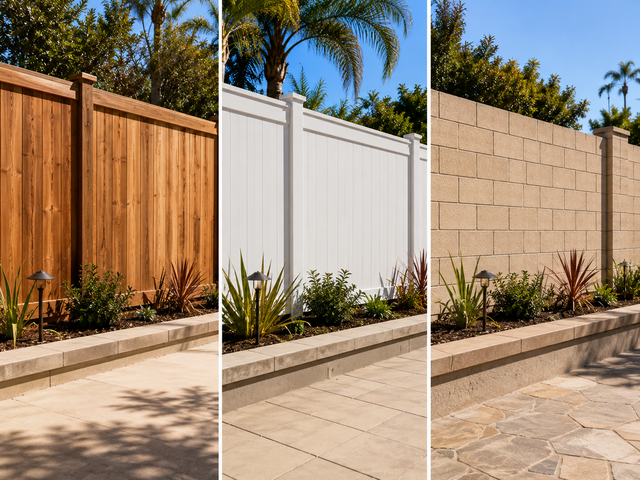
QUICK ANSWER
For the lowest routine finish maintenance, a quality vinyl fence can be a strong choice when it is properly installed and appropriate for the site's wind and wildfire exposure. For a natural look and easy board-by-board repair, wood remains compelling but needs the most ongoing finish and moisture management. For the most permanent privacy boundary and a noncombustible material, a properly designed concrete masonry block wall is usually the strongest long-term construction choice — but it is also a fundamentally different scope involving footing, reinforcement, movement, drainage, and permit considerations.
A new fence can look perfect on installation day and still become a maintenance problem later. Wood weathers and moves, vinyl reduces finish maintenance but still depends on product quality and reinforcement, and a block wall offers permanence at a higher construction scope. For homeowners comparing the best fence material for a hot dry climate, the honest test is not a single lifespan number. It is how wood, vinyl, and block each respond to sun, heat, irrigation overspray, wind, soil movement, and wildfire exposure — and which repairs you are willing to make. This guide compares those tradeoffs by failure mode, so you can choose the maintenance burden and the eventual problem you can live with, rather than the material that only looks best in the showroom. For basic types and installation, start with our fence installation and material guide, then use this comparison to match the system to your property.
Hot and Dry Does Not Mean the Fence Stays Dry
Southern California's climate sounds simple until you look at what a fence actually experiences.
- Direct ultraviolet exposure for long periods of the year.
- Large surface-temperature swings between sun and shade.
- Irrigation overspray concentrated at the bottom of posts and boards.
- Occasional rain followed by rapid drying.
- Wind pressure on large privacy panels.
- Soil movement around posts or masonry footings.
- Vegetation and mulch held against the fence line.
- For some properties, wildfire and radiant-heat exposure.
That is why "fence lifespan California" is not one honest number. Material matters, but installation, exposure, detailing, maintenance, and site conditions can move the result dramatically.
How Each Fence Material Actually Fails
| Material | What Heat / Sun Does | Typical Failure Mode | Maintenance Pattern | Best Fit |
|---|---|---|---|---|
| Wood fence | UV weathers the surface; moisture cycling drives dimensional movement | Warping, cupping, checking, splitting, gray weathered surface, post or base deterioration if moisture persists | Highest of the three; finish and moisture management matter | Natural appearance, repairable sections, homeowners comfortable with maintenance |
| Vinyl fence | PVC profiles expand and contract; quality exterior compounds are designed and tested for weatherability | Panel movement, distortion or sagging if product or installation is poor; impact damage; radiant-heat deformation in wildfire exposure | Low routine finish maintenance; cleaning and hardware/post checks | Consistent appearance, low finish maintenance, sites where fire-path concerns are addressed |
| Concrete masonry block wall | Does not warp from heat like boards or panels | Cracking, leaning, joint deterioration, efflorescence or water issues if structure, drainage, or detailing are wrong | Low finish maintenance, but structural or mortar cracks should not be ignored | Permanent privacy, mass, noncombustible boundary, long-term hardscape integration |
Wood Moves Because It Is Wood
When homeowners describe a warping fence, they often blame heat alone. The more accurate explanation is moisture movement plus weathering. The USDA Forest Products Laboratory explains that wood continually responds to surrounding humidity, and moisture-content changes create dimensional changes. Correct drying, storage, construction moisture, detailing, and coatings can reduce the severity of that movement but cannot make wood dimensionally inert. Sunlight adds another layer. Outdoor UV exposure degrades the wood surface and contributes to the familiar color change and roughening that happens when wood is left to weather.
Why Some Wood Fences Warp Faster Than Others
- Boards were installed too wet and then dried unevenly in service.
- One face receives intense sun while the other stays cooler or wetter.
- Irrigation repeatedly wets the bottom edge or one side of the fence.
- Wide boards or poorly restrained boards move more visibly.
- Species, grain orientation, grade, board thickness, and fastener pattern are poorly matched to the design.
- A finish was skipped, allowed to fail, or applied to weathered or improperly prepared wood.
- Posts move because soil, footing, drainage, or decay conditions are weak.
The practical point is important: a wood fence can be well built and still change appearance. Gray color alone is not the same thing as structural failure. A board that twists out of plane, splits at fasteners, or pulls the assembly out of alignment is a different issue from normal surface weathering.
When a Wood Fence Is Worth It
Choose wood because you want what wood does well, not because you expect it to behave like vinyl.
- You value a natural material and the ability to stain or change the appearance later.
- You prefer individual components that can often be repaired or replaced without rebuilding the entire run.
- You accept periodic inspection and finish maintenance.
- The fence line can be detailed to reduce irrigation contact and trapped moisture.
- The architectural style benefits from real wood grain and variation.
WOOD REALITY CHECK
If "low maintenance fence" is your number-one goal, wood usually should not be the default. If natural appearance and repairability matter more, and you are willing to maintain the finish and moisture details, wood can still be the right long-term choice.
Vinyl Is Low Maintenance Not No Engineering
The vinyl vs wood fence debate often gets reduced to one sentence: vinyl is maintenance-free and wood warps. That is too simple. Rigid PVC fence profiles are covered by ASTM F964, whose current active edition includes requirements and testing related to weatherability, dimensional stability, warp, impact resistance, and impact after weathering. Installation practice also matters; ASTM maintains a separate installation practice for rigid PVC fence systems. That tells you something useful as a buyer: the quality of the profile and the quality of the installed system matter. "Vinyl" is a category, not a guarantee.
What Heat Actually Means for Vinyl
PVC expands and contracts as temperatures change. A correctly designed fence system has to accommodate that movement while the posts, rails, panels, hardware, and any internal reinforcement remain aligned. Problems are more likely when a low-quality profile, long unsupported spans, poor post setting, inadequate reinforcement, or installation that ignores movement is combined with strong solar exposure and wind. The better question is not "Will vinyl get brittle in heat?" It is:
- Does the product comply with a recognized exterior fencing standard such as ASTM F964?
- What does the manufacturer require for post spacing, reinforcement, gates, and high-wind conditions?
- How does the system accommodate thermal movement?
- What does the warranty actually cover for color, impact, or profile performance?
- Is the exact color approved for the climate and exposure? Darker polymer colors can behave differently from traditional light PVC systems.
The Wildfire Note Vinyl Buyers Should Not Skip
In Southern California, fence selection can also be a home-hardening decision. CAL FIRE notes that vinyl fences are less vulnerable to embers than some combustible fencing, but they can ignite under direct flame exposure and can deform from radiant heat. CAL FIRE also warns that combustible fences attached to a residence can create a direct fire pathway and recommends noncombustible fencing near the home as part of its home-hardening guidance. That does not make vinyl a bad material everywhere. It means wildfire exposure, vegetation, fence-to-house connection, and local fire-hazard conditions should be checked before treating vinyl as the universal low-maintenance answer.
When a Vinyl Fence Is Worth It
- You want a consistent appearance without recurring stain or paint maintenance.
- You are willing to compare actual profile quality rather than shopping only by panel style.
- The system can be installed with correct post spacing, reinforcement, gate hardware, and movement allowance.
- The fence is not being used in a location where wildfire or radiant-heat strategy points toward a noncombustible boundary.
- You accept that damaged panels or profiles may be less locally repairable than individual wood boards.
Block Wall vs Fence Is a Construction-Scope Decision
A concrete masonry block wall is often discussed as if it were just a more durable fence panel. It is not. A block wall is a heavier site structure. Depending on height, location, retaining conditions, soil, slopes, nearby structures, and jurisdiction, it can involve a footing, reinforcement, grout, movement and control joints, drainage details, engineering, planning review, and permits. The Concrete Masonry and Hardscapes Association's technical guidance emphasizes that exterior masonry performance depends on the entire wall assembly — unit properties, mortar joints, workmanship, moisture detailing, and movement accommodation — not simply on choosing concrete block. That is why a poorly built wall can crack or lean even though the material itself never "warps."
What Makes a Block Wall Last
- A footing appropriate to the wall, soil, height, and loads.
- Reinforcement and grout where required by design and code.
- Proper wall alignment and workmanship.
- Control and movement detailing appropriate to the wall length and conditions.
- Moisture management at the top, joints, grade, and adjacent planting.
- Proper drainage when the wall is retaining soil or exposed to water pressure.
- No assumption that a freestanding privacy wall can be detailed like a retaining wall, or vice versa.
For heavier permanent site work, the broader hardscaping services context is useful because a masonry wall often needs to coordinate with paving, grade, drainage, steps, retaining conditions, and adjacent landscape work rather than being treated as an isolated fence replacement.
When a Block Wall Is Worth It
A block wall becomes compelling when the goal is more permanent than "I need a fence."
- You want a highly durable privacy boundary with very little routine surface maintenance.
- Noncombustible material is important for the site or home-hardening strategy.
- You want mass and a solid visual boundary rather than a lightweight panel system.
- The property layout supports footing and construction access.
- You are prepared to treat it as structural or site construction, including permit and engineering review where required.
The tradeoff is complexity. A fence can often be installed as a relatively light system of posts and panels. A masonry wall asks more from the ground below it and the details around it.
Fences and Walls Are Not Treated the Same
Fence and wall rules vary across Southern California cities, and height is not the only trigger. As one current local example, the City of Glendale requires planning review steps for proposed fences and walls and states that freestanding fences and walls require a building permit when taller than 7 feet, when retaining conditions reach specified thresholds, or when certain slope, right-of-way, adjacent-structure, or surcharge conditions apply. That is an example, not a rule for every city. Before choosing a taller privacy wall, corner-lot fence, retaining wall, or fence on or near a slope, verify how permit triggers like height and surcharge work for the property's jurisdiction and HOA if applicable.
CODE NOTE
In 2026, California is operating under the 2025 California Building Standards Code, effective January 1, 2026. Local zoning, planning, fire-hazard, and permit rules can add requirements. Material choice should follow the actual site and jurisdiction, not a generic SoCal height rule.
Fence Lifespan in California Depends on the Failure Mode
Homeowners often search for a single lifespan number so they can choose the longest-lasting option. The problem is that published lifespan ranges usually hide the variables that actually decide what you will live with. Instead of asking "How many years does this material last?" ask five better questions:
- What is most likely to fail first — the board or panel, the post, the footing, the hardware, the finish, or the drainage around it?
- Can that failed component be repaired locally, or does a large section have to be replaced?
- What maintenance has to happen before damage becomes visible?
- How exposed is this fence line to irrigation, western sun, wind, soil movement, and wildfire?
- Will replacement components, colors, or profiles still be available if one section is damaged years later?
That framework is far more useful than comparing optimistic life-expectancy numbers from unrelated products and climates.
Low-Maintenance Fence Options Weigh Upkeep Against Permanence
If your definition of low maintenance is "I do not want to stain or paint it," vinyl is usually the clearest fence-category answer. If your definition is "I want the boundary itself to need very little routine attention for the long haul," a correctly designed masonry wall can be even more hands-off, but it is not the same type of project. Wood is the choice that asks the most ongoing attention, especially if you want to preserve a particular color or finish rather than allowing natural weathering. None of the three is literally maintenance-free:
- Wood needs finish and moisture inspection and occasional component repair.
- Vinyl needs cleaning plus checks of gates, hardware, posts, movement, and impact damage.
- Block walls need cracks, joints, drainage, settlement, vegetation, and water exposure watched before small issues become structural-looking problems.
Privacy, Sound, Wind, and Repairability Change the Decision
| Priority | Wood | Vinyl | Block Wall |
|---|---|---|---|
| Natural appearance | Strongest | Manufactured, consistent | Architectural but solid and heavy |
| Low finish maintenance | Weakest | Strong | Strong |
| Board or panel-level repair | Strong | Product and system dependent | Masonry repair is specialized |
| Solid visual privacy | Strong with tight design | Strong with privacy panels | Strongest continuous barrier |
| Wind sensitivity | Panel and post design matters | Panel, post, and reinforcement design matters | Structural design and footing matter |
| Wildfire near residence | Combustible; location and detail matter | Can deform or ignite under flame or radiant exposure | Noncombustible material advantage |
| Tolerance for soil/footing errors | Posts can lean or move | Posts can lean or move | Cracking or leaning can be serious because the wall is heavy |
| Visual aging | Grays and checks unless maintained | More consistent, product-dependent | Stable mass; joints and coatings may weather |
If a living boundary is also on the table, compare these systems against the best privacy hedges for Southern California, which trade construction for planting and growth time.
Common Fence and Wall Mistakes to Avoid
- Do not blame every warped wood board on heat. Moisture content, drying, grain, restraint, finish, and installation are central to dimensional movement.
- Do not buy vinyl based only on panel thickness or color. Ask about the complete system, standard compliance, posts, reinforcement, hardware, wind conditions, and installation instructions.
- Do not call vinyl "maintenance-free." It eliminates many wood-finish tasks, but the fence still needs inspection and cleaning.
- Do not assume a block wall cannot fail because concrete masonry is durable. Footing, reinforcement, soil, drainage, workmanship, and movement detailing control the wall as a system.
- Do not turn a fence into a retaining wall without designing for soil pressure and drainage.
- Do not ignore irrigation. Repeated wetting at the base can accelerate wood deterioration, create staining and mineral deposits, and undermine soil conditions around posts or wall footings.
- Do not attach a combustible fence to the house in a wildfire-prone setting without reviewing current home-hardening guidance and local requirements.
- Do not choose the tallest privacy option before checking planning, property-line, corner-visibility, slope, HOA, and permit rules.
Which Fence or Wall Is Worth It?
| If This Sounds Like You | Best Starting Point | Verify Before You Commit |
|---|---|---|
| I want the natural look and easy local repairs | Wood | Species and grade, moisture, finish plan, post and base drainage, irrigation exposure |
| I want the least finish maintenance from a fence system | Vinyl | ASTM F964 profile quality, installation system, wind and reinforcement, color, wildfire exposure |
| I want a permanent solid privacy boundary | Block wall | Footing, reinforcement, soil, drainage, permits, movement joints, access |
| My fence line connects directly to the house in a fire-prone area | Noncombustible transition or block-wall strategy deserves priority review | Current CAL FIRE home-hardening guidance, local WUI and fire rules |
| I have a narrow side yard and difficult access | Wood or vinyl may be logistically simpler | Post excavation, material delivery, gate width, utilities |
| The boundary also retains soil or sits by a slope | Engineered wall solution | Retaining loads, drainage, surcharge, geotechnical and site conditions, permit requirements |
Choose the Best Fence Material for Your Climate
Every exterior boundary ages. The useful goal is not to find a material that never changes; it is to choose the failure mode you can live with. Wood asks for the most care but gives you natural character and straightforward component repairs. Vinyl dramatically reduces finish maintenance, but quality, installation, thermal movement, wind, and wildfire exposure matter more than the word "vinyl." Block masonry removes the warping question entirely, but replaces it with structural, footing, drainage, and permit questions. That is the real answer to the best fence material for a hot, dry Southern California climate: not the one that lasts longest on paper, but the one whose maintenance and eventual repairs fit your property. Compare sun exposure, irrigation, wind, wildfire, maintenance tolerance, repairability, privacy, construction access, and permit complexity before choosing. For a property-specific comparison, book a fence and wall consult or call +1 (818) 303-1570.
Frequently Asked Fence and Wall Material Questions
What's the Best Fence Material for a Hot Climate?
There is no universal winner. A quality vinyl fence is often a strong low-maintenance option when the system is correctly designed for sun, wind, and thermal movement. Wood is best when natural appearance and repairability matter and regular maintenance is acceptable. A properly designed concrete masonry block wall is the most permanent and noncombustible of the three, but it is a heavier structural and site-construction choice rather than a simple fence panel system.
Is Vinyl Better Than Wood Fence in Southern California?
Vinyl is usually lower maintenance because it does not require the same recurring stain or paint care as wood. Wood offers natural appearance and straightforward board-level repairs but moves with moisture and weathers in sunlight. Vinyl performance depends on profile quality, standard compliance, posts, reinforcement, installation, and exposure. The better choice depends on whether you prioritize natural material, low finish maintenance, repairability, wind performance, or wildfire strategy.
Why Is My Wood Fence Warping?
Wood warping is usually tied to moisture-content changes, uneven drying and wetting, grain orientation, board dimensions, installation moisture, restraint, and exposure — not heat alone. Irrigation on one side, intense sun on the other, poorly dried boards, wide boards, or weak fastening and post conditions can make movement more visible.
Does Vinyl Fence Warp or Become Brittle in SoCal Heat?
Do not assume either outcome is inevitable. Rigid PVC fence profiles are covered by ASTM F964, which addresses weatherability, dimensional stability, warp, and impact-related performance. A good exterior fencing system should be selected and installed for the expected exposure. Poor-quality profiles, inadequate support, ignored thermal movement, impact, or radiant or direct flame exposure can still create problems.
Is a Block Wall Better Than a Fence?
A block wall is better when you need a permanent solid boundary, noncombustible material, and masonry-level privacy and mass. A fence may be better when lighter construction, easier access, component-level repair, or a less permanent boundary is more appropriate. The wall also requires more attention to footing, reinforcement, soil, drainage, movement, and permits.
Which Option Is the Lowest Maintenance Fence?
Among actual fence systems, vinyl generally requires the least finish maintenance because it does not need recurring stain or paint. It still needs cleaning and checks of posts, gates, hardware, movement, and damage. A masonry wall may need even less routine finish attention, but it is not the same type of construction as a fence.
What Affects Fence Lifespan in California the Most?
Material is only one factor. Sun and UV exposure, irrigation, moisture cycling, post and footing design, soil movement, wind, fasteners, finish maintenance, vegetation, drainage, installation quality, and wildfire exposure can all affect service life. It is more useful to identify the likely failure mode and repair strategy than to rely on one generic lifespan number.
Do I Need a Permit for a Fence or Wall?
Requirements vary by city and site. Height, retaining conditions, slopes, rights-of-way, corner visibility, surcharges, and nearby structures can all matter. Glendale, for example, currently requires planning review steps for proposed fences and walls and identifies specific conditions that trigger a building permit. Verify current requirements for the property before construction.
What Fence Material Is Better for Wildfire-Prone Areas?
Noncombustible materials deserve priority consideration near the home. CAL FIRE notes that combustible fences can create a fire pathway and that vinyl can deform from radiant heat and ignite with direct flame exposure. Its home-hardening guidance recommends noncombustible fencing near the residence. Site-specific fire hazard, vegetation, attachment to the house, and local rules should be reviewed before choosing the system.
Thinking about a new outdoor space?
We’d love to hear your ideas. Let’s explore what’s possible—no pressure, just a friendly conversation.
Give us a call:
+1 (818) 303-1570
Frequently Asked Question
WHY SHOULD I PAY FOR A LANDSCAPE DESIGN WHEN SOME COMPANIES DO IT FREE?
There is a huge difference between price and value. Good landscape project can increase the value and curb appeal of a home and provide many years of beauty and enjoyment. Poor landscaping is a liability and wasting money. Some companies may offer a "free plan" but hide their time spent in the cost of the installation. Others will spend minimal time on your project or be unqualified.... and you will get exactly what you pay for.