
OUR MISSION IS TO TAILOR FOR EACH CLIENT A BEAUTIFUL, FUNCTIONAL AND ENDURING OUTDOOR ENVIRONMENT THAT WILL PROVIDE A PLACE OF SERENITY FOR FRIENDS AND FAMILY TO APPRECIATE FOR YEARS TO COME.

BuildCal Landscape Pergolas Article
Pergola vs Patio Cover in Southern California
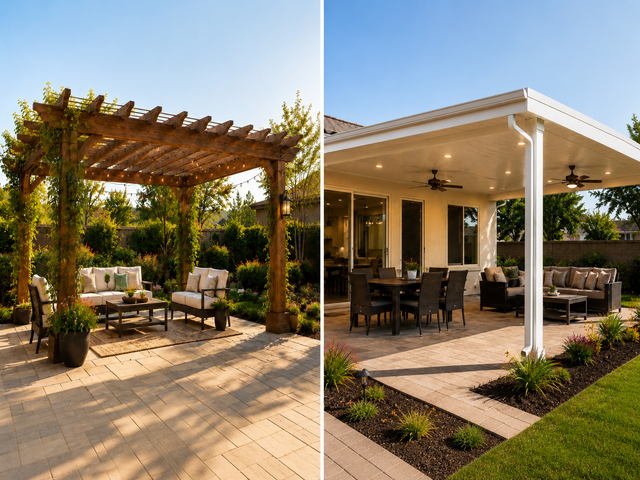
Adding shade to a patio is one of the most popular upgrades in Southern California — but the first decision, pergola vs patio cover, trips up a lot of homeowners. They look similar in a showroom, yet they perform very differently under the Glendale, CA sun, carry different permit considerations, and land at different price points. Choosing the right one comes down to how much shade you want, how much airflow you like, and how you plan to use the space.
This guide is a practical shade structure comparison built for the SoCal climate: clear definitions, how each handles sun and heat, what permits to expect in Glendale, the factors that drive cost, and a simple way to decide. If you already know you want an open-roof structure, you can jump straight to our custom pergola work.
Definitions
The core difference is the roof. Everything else follows from it.
- Pergola. An open-roof structure with evenly spaced rafters or slats overhead. It casts partial, dappled shade, lets air and light through, and can be attached to the house or freestanding. Adjustable louvered versions let you open or close the roof as the sun moves.
- Patio cover. A solid-roof structure that fully covers the space below. It blocks direct sun and sheds rain, creating a shaded "outdoor room" — but with less airflow than an open design unless it's vented.
Both are common across SoCal patios, and both pair well with surfaces like a paver patio. You'll also see hybrids — solid covers with lattice sections, or louvered pergolas that behave like a patio cover when closed.
Shade & Airflow
In a hot, sunny climate, shade performance is where pergola vs patio cover really separates.
A pergola delivers filtered, moving shade and keeps air circulating, so the space feels breezy rather than stuffy. The trade-off is that a standard open pergola won't fully block the midday sun or rain on its own — though a canopy, climbing plants, or adjustable louvers can increase coverage when you want it. A patio cover, by contrast, gives full, consistent shade and rain protection, making it ideal for a true covered lounge or dining room outdoors. The trade-off there is airflow: a solid roof can trap warm air on still summer days unless it includes venting or a fan.
For SoCal sun specifically, think about when you use the space. Afternoon entertaining under intense sun leans toward fuller coverage; relaxed morning-and-evening use often suits a breezier pergola. Either way, outdoor lighting extends the hours you can enjoy it, and comfortable outdoor seating chosen for the climate completes the space.
Permits in Glendale
Both structures usually require a permit in Glendale, CA, because they're permanent shade structures — and attached versions almost always do. Permitting reviews things like height, setbacks from property lines, how the structure attaches to the home, and any electrical work for lights or fans. Solid patio covers may face additional review because they fully enclose overhead space.
The practical takeaway: factor permitting into your plan from the start, not as an afterthought. Our detailed guide to permit requirements for a pergola, deck, or patio cover walks through what to expect. Most projects route through the City of Glendale building and safety division, while some hillside or boundary properties fall under Los Angeles County Public Works. A contractor who manages permits for you — covered in our guide to what a hardscape contractor should include — keeps the project compliant and on schedule.
Cost Factors
Without quoting prices, here are the factors that move the cost of either structure — useful for comparing quotes apples to apples.
- Material. Wood (cedar or redwood), aluminum, and vinyl differ in price, lifespan, and upkeep. Material choice should also suit the climate — see choosing materials for the local climate.
- Roof type. A solid patio cover generally uses more material than an open pergola; adjustable louvered roofs cost more than fixed slats.
- Size and attachment. Larger spans and attached structures (which tie into the home and may need more engineering) add cost versus small freestanding builds.
- Foundation and site. Footings, the surface below, slope, and access all factor in — much like the cost drivers in our comparison of patio materials and value.
- Add-ons. Integrated lighting, ceiling fans, privacy screens, and motorized louvers each add to the total — and to the comfort.
Because these variables stack differently on every property, an accurate number comes only from a site visit, not a phone estimate.
Which to Choose
Use this simple decision guide to settle the pergola vs patio cover question for your yard.
- Choose a pergola if you want airflow, light, and an open, architectural look; you mainly need partial shade and a breezy feel; or you like the option to add a canopy, plants, or louvers over time.
- Choose a patio cover if you want full, all-day shade and rain protection, or a true covered outdoor room for year-round dining and lounging.
- Consider a louvered pergola if you want the best of both — open it for a breeze, close it for full shade or light rain.
Whatever you choose, design it as part of the larger space — alongside the patio, planting, and any outdoor kitchen or entertaining area — so it becomes a true outdoor living space rather than a standalone add-on. See finished examples in our portfolio.
Ready to Add Shade to Your Patio?
If you've weighed pergola vs patio cover and want help choosing the right structure for your SoCal sun, slope, and lifestyle, we'll walk your space and design it to fit. Start Your Pergola Project by calling +1 (818) 303-1570 or contact us to schedule a consultation — and explore our pergola designs for inspiration.
Frequently Asked Questions
What's the difference between a pergola and a patio cover?
A pergola has an open roof of spaced rafters or slats, giving partial, dappled shade and good airflow. A patio cover has a solid roof that fully blocks sun and sheds rain, creating a shaded outdoor room with less airflow. The roof is the core difference, and everything else - shade level, breeze, and feel - follows from it.
Which gives better shade in Southern California - a pergola or a patio cover?
For full, all-day shade and rain protection, a patio cover wins. For a breezy, brighter space with filtered shade, a pergola is better - and it can be upgraded with a canopy, plants, or adjustable louvers for more coverage. The right choice for the SoCal sun depends on when you use the space and whether airflow or full coverage matters more.
Do I need a permit for a pergola or patio cover in Glendale?
Usually yes. Both are permanent shade structures, and attached versions almost always require a permit. Reviews typically cover height, setbacks, attachment to the home, and any electrical work for lights or fans. Plan for permitting from the start; a contractor who manages it keeps the project compliant and on schedule.
Is a pergola or a patio cover more expensive?
It depends on material, size, roof type, attachment, foundation, and add-ons - not the category alone. A solid patio cover often uses more material than an open pergola, and adjustable louvered roofs cost more than fixed slats. Because the variables stack differently on every property, an accurate figure comes from a site visit rather than a phone estimate."
Can a pergola be made to block more sun?
Yes. A standard open pergola gives partial shade, but you can increase coverage with a retractable canopy, climbing plants, shade cloth, or adjustable louvers that open and close as the sun moves. A louvered pergola is a popular middle path - breezy when open, fully shaded when closed. Start Your Pergola Project at +1 (818) 303-1570 to explore options.
Thinking about a new outdoor space?
We’d love to hear your ideas. Let’s explore what’s possible—no pressure, just a friendly conversation.
Give us a call:
+1 (818) 303-1570
Frequently Asked Question
CAN YOU GIVE ME AN ESTIMATE FOR MY PROJECT DURING THE INITIAL CONSULTATION?
No, Too often a landscape contractor will come to a site and immediately give a potential client a price without first knowing all the details of that project. Our first question is always, “What is this estimate based on?” Before making out a bid of any sort, we must first discuss all the work to be done, the planting and construction materials necessary, and the labor involved. After which we do a breakdown and present to you a complete and itemized preliminary estimate. As our client you will be able to see, not only how much your project will cost, but also where every dollar will go.